The 5 layers of software – what you need to know
29 December 2022 | Noor Khan


For your software to operate efficiently, effectively, and remain usable through scalability changes and upgrades, it is important to understand how the 5 layers of software are built, and what the different aspects are doing – both separately and individually.
When deciding on software for your business, you may choose to have an in-house team design and create your desired program, or you could outsource the process. Understanding what you need, what you should be looking for, and how these programs are structured will help you to determine how you should approach your software development needs, and identify what is essential, nice to have, or non-essential, allowing you to make more effective use of your time and budget.
What are the 5 layers of software?
One of the most popular architectural patterns for software is layered architecture for multi-layer software. The infrastructure is generally divided into five layers:
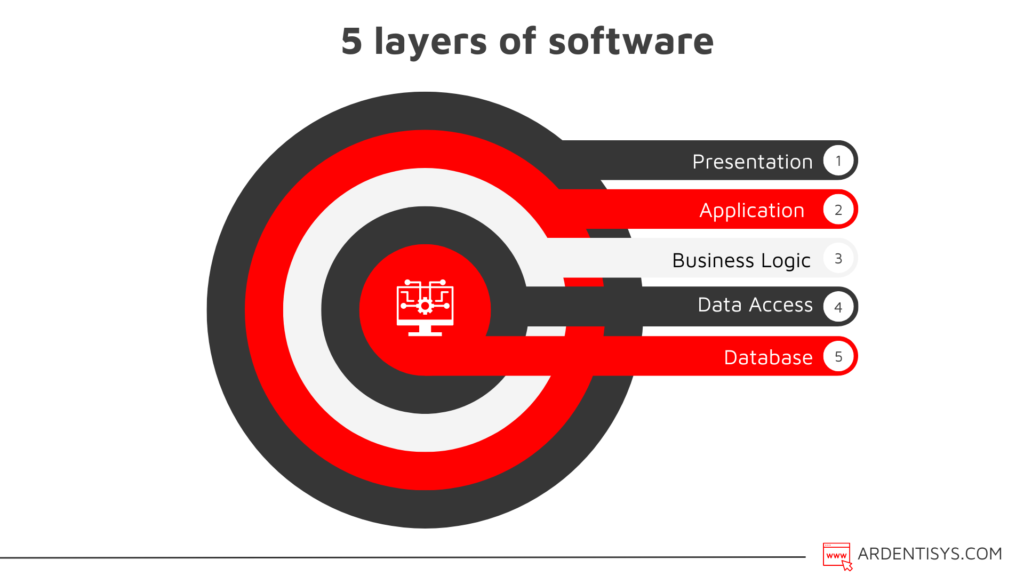
Presentation - User Interface (UI) layer
This is the top layer of the application and, as the name suggests, provides the presentation of the content to the end user. This layer is accessed through client devices – such as mobile phones, tablets, desktops, laptops, etc. This tier can only function when it is interacting correctly with the layers below it.
Application - Service layer
This is a mid-level tier that the application logic runs, it covers the defined rules which have been programmed into the program in order to run the application. This layer is run on one or more application servers and is the layer where programmers spend a considerable amount of their time when working on software development.
Business Logic - Domain layer
This mid-level layer collects together the rules of the system and determines the behaviour of the entire application. It ensures that when one action completes, the application knows what to do next.
Data Access - Persistence layer
This lower-tier layer has a protective function and contains code which is required to access the database layer below it. This tier also generally includes coding which allows for various manipulations on different aspects of the database – such as SQL statements, and details of the connection.
Database
The lowest level of the software architecture, this level is largely concerned with the application data, both storing it and retrieving it for use. The data for the software is often stored on a database server or file server but can also be stored on any device or media which supports data access logic.
Five-tier structure Vs three-tier structure
Not all software uses a 5-tier architectural structure, some will use the minimum value of 3 (presentation, application, and data access). How the software is set up and operated will vary depending on what it is intended to be used for, the type of coding language involved in the creation, and what code has been created to manage the tasks.
Three-tier software can be complex for developers to make application changes, especially when agility and flexibility is required to keep pace with the expectations of end users. A five-tier structure allows for increased scalability, flexibility, ease of management, and the addition of increased security.
The more agile and innovative your software, the more complex your needs will be – and the more appropriate it is for you to seek expert advice on your product development from highly experienced engineers, who can help you create a product that is scalable and suitable for your business now and in the future.
Ardent software development services
At Ardent, we take on your challenges and requirements and deliver a solution that will help you overcome your challenges today and in the future. Our team of highly experienced software developers can help bring your vision to life, employing world-leading technologies in the world including the likes of Ruby on Rails, Angular, MongoDB, .NetCore, Python and much more.
Explore stories on the success of our clients with thier software:
Get in touch to find out more or to get started on making your software a reality.
Ardent Insights
Which Platforms Are Ahead in AI-Ready Data Pipelines?
At Ardent, we have spent years helping organisations design, modernise and operate the data foundations behind critical reporting, analytics and decision-making. That experience gives us a clear view of what now separates AI-ready businesses from those still struggling to get value from their data. It is not the amount of data they hold, or even [...]
Read More... from The 5 layers of software – what you need to know
Making Your Existing Data Pipelines AI-Ready
From Stable Infrastructure to Adaptive Intelligence Most organisations do not need more data. They need their existing data to work better. At Ardent, we spend a significant amount of time inside large-scale client data platforms that are already mature, operational, and delivering value. These are not greenfield environments. They are complex ecosystems built over years, [...]
Read More... from The 5 layers of software – what you need to know
AI-Powered ETL in Amazon Redshift
When the Warehouse Starts Doing the Work In our previous piece, we explored how ETL (Extract, Transform, and Load) is evolving into adaptive, intelligent systems. In Redshift environments, we are now seeing what that shift looks like in practice. For most of its life, Amazon Redshift has been treated as the final step in the [...]
Read More... from The 5 layers of software – what you need to know
Services
About
UK
US
India

