AWS EC2 Vs Azure VM – Comparing Cloud Technologies
18 August 2022 | Noor Khan


When it comes to choosing a cloud service, it’s fair to say that the more advanced they get, the more options become available, and the more difficult it can be to decide what technology best suits your specific needs. AWS EC2 and Azure VM are technologies offered by leading technology brands, Amazon and Microsoft.
To help you decide, we’re comparing Amazon’s EC2 and Microsoft’s Azure VM.
What does AWS EC2 provide?
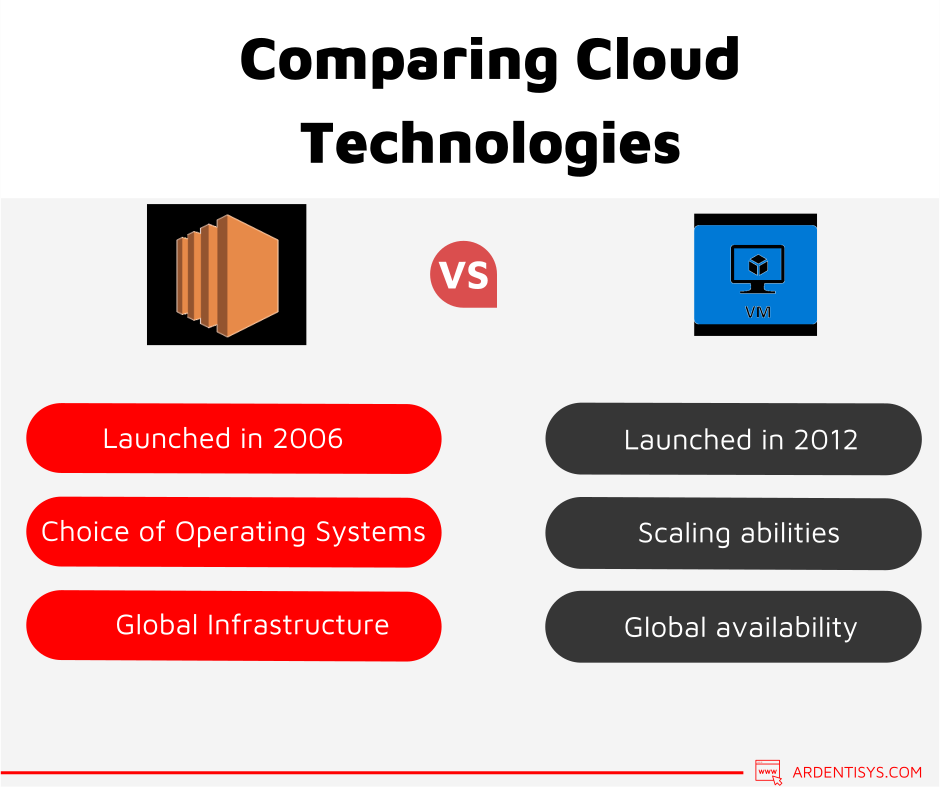
Amazon’s Web Services (AWS) Elastic Compute Cloud (EC2) has been generally available since August 2006, and has global availability, operating in 25 regions.
The service has a diverse list of Virtual Machine (VM) types, and it’s known for providing secure and resizable computing capacity, with easy access and usability.
Some of the features that are provided with EC2 include:
- Global infrastructure made up of ‘Regions’ and ‘Availability Zones’
- A choice of Operating Systems (OS)
- Auto-Scaling
- Optimised CPU configurations
- Hibernation / Pause and Resume of Instances
- Enhanced networking
- High SLA commitment (99.99% availability)
Pros and cons of the AWS EC2 cloud technology
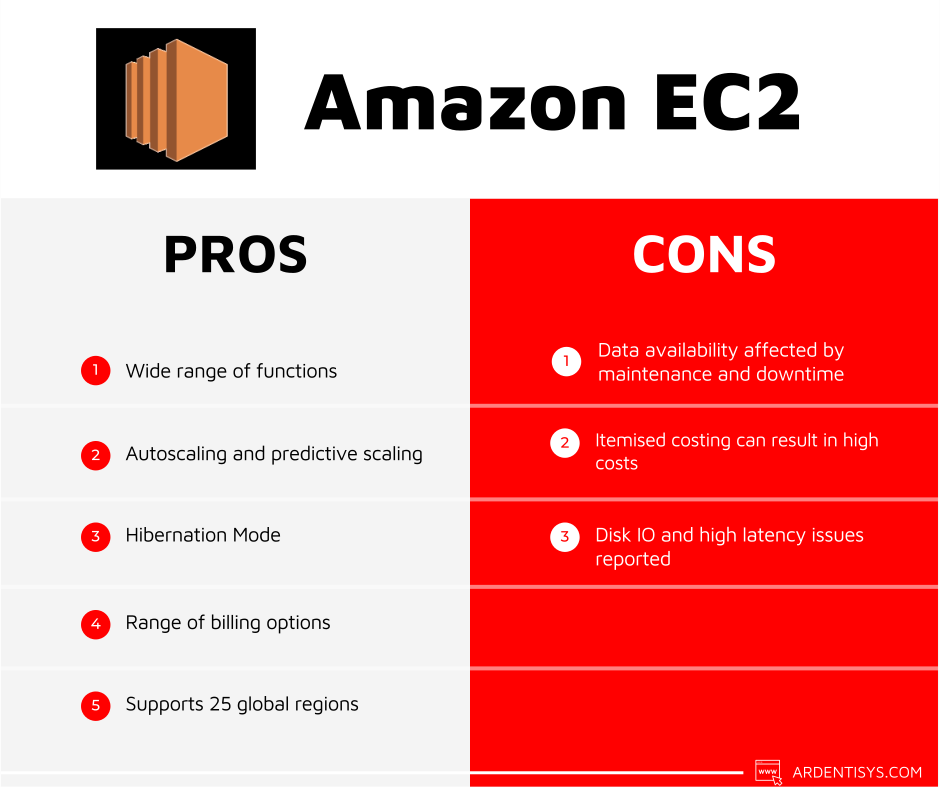
Pros:
- Offers a wider range of functions for computing and storage optimisation usage
- Autoscaling allows for predictive scaling, a machine learning approach, and the ability to automatically build policies based on user-provided strategies
- Hibernation mode
- AWS offers a wide range of billing options (On-Demand, Reserved, Spot, and Savings Plan)
- Supported in 25 global regions
Cons:
- Server maintenance and downtime can affect availability
- May not be cost-effective for medium to large-scale usage due to the itemised costing
- Variable performance and bottleneck issues reported with disk IO and high latency
What does Azure VM provide?
Azure VM also has global availability (33 regions) and has been generally available since June 2012. It is a Microsoft cloud technology with flexible virtualisation, offering services for general purpose, compute optimisation, memory optimisation, storage optimisation, and accelerated high-performance usage.
The service allows for up to 416 vCPUs, 12TB of memory, and 30Gbps ethernet, and is the first cloud development that offers 200Gbps ‘Infiniband’.
Azure uses a range of metrics to trigger scaling events, their Virtual Machine Scale Sets (VMSS) and VMs are managed as a ‘unit’, which can be scaled up and down when thresholds are met – or the scaling can be adjusted on a set schedule.
The Azure cloud platform covers more than 200 products and cloud services and is designed to help users build, run, and manage their applications.
Pros and Cons of the Azure VM Technology
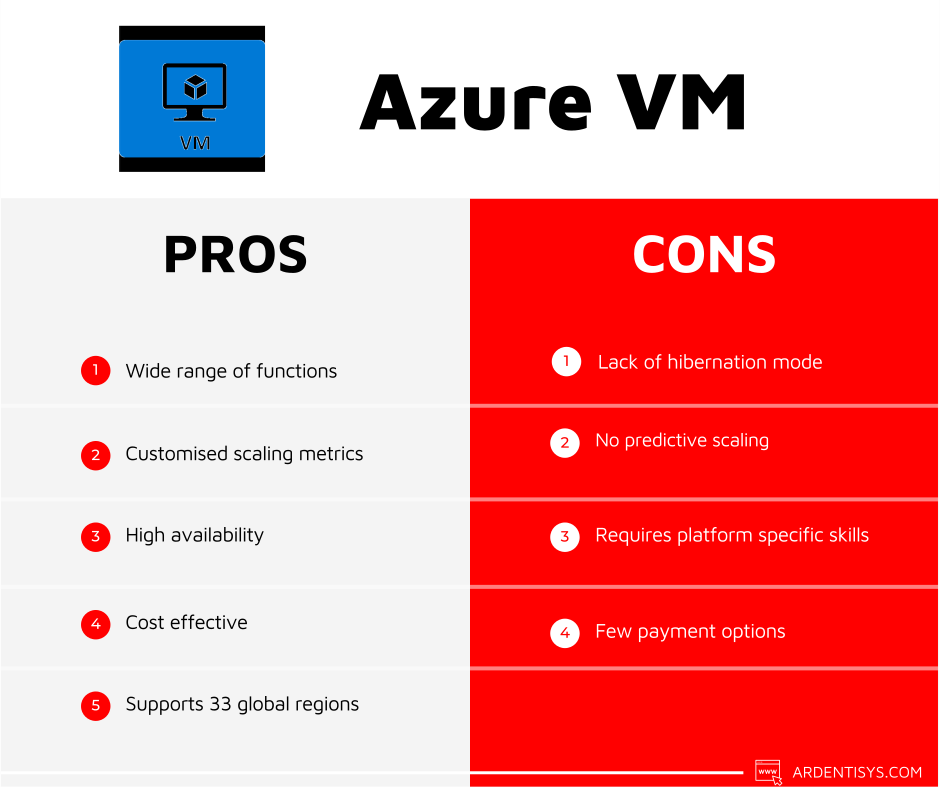
Pros:
- Offers a wider range of functions for General Memory and Accelerated / High-Performance usage
- Scaling metrics can be user-specified and customised to requirements
- High availability
- Cost-Effective usage options
- Supported in 33 global regions
Cons:
- Does not have a hibernation mode
- No predictive scaling options
- Requires platform expertise
- Fewer payment options (On-Demand, Reserved, and Spot)
AWS EC2 Vs Azure VM - Decide by balancing use, need and function
Both services are comparable in their initial pricing structures and have global availability. Users of the technologies have said that AWS EC2 is easier for beginners to use, due to its high levels of automation and feature – and that Azure, with its ability to use your own OS (Operating System), language, database, and tools of choice, is better for more advanced users.
At the end of the day, the choice between these two data-engineering tools is going to come down to your specific needs, your competence (and confidence) with the operations, and exactly what it is you want to use the service for.
Ardent data engineering services
With Ardent, you do not have to take the burden of researching technologies to make the right decision. You tell us your problems and challenges and we will find a solution with the technologies most suitable to provide the best outcome. Our highly skilled data engineers have been providing data engineering services for over a decade and have worked with a variety of technologies to make a recommendation based on your need. However, if you do have preferred technologies like our clients, we can accommodate that too. Discover how some of our customers succeeding with leading technologies:
- Monetizing broadcasting data reliable and timely data availability for real-time, mission-critical data
- Improving data turnaround by 80% with Databricks for a Fortune 500 company
- Powerful insights driving growth for global brands with robust, scalable data pipelines with AWS infrastructure
Get in touch today and let Ardent help you face your data challenges.
Ardent Insights

Which Platforms Are Ahead in AI-Ready Data Pipelines?
At Ardent, we have spent years helping organisations design, modernise and operate the data foundations behind critical reporting, analytics and decision-making. That experience gives us a clear view of what now separates AI-ready businesses from those still struggling to get value from their data. It is not the amount of data they hold, or even [...]
Read More... from AWS EC2 Vs Azure VM – Comparing Cloud Technologies

Making Your Existing Data Pipelines AI-Ready
From Stable Infrastructure to Adaptive Intelligence Most organisations do not need more data. They need their existing data to work better. At Ardent, we spend a significant amount of time inside large-scale client data platforms that are already mature, operational, and delivering value. These are not greenfield environments. They are complex ecosystems built over years, [...]
Read More... from AWS EC2 Vs Azure VM – Comparing Cloud Technologies

AI-Powered ETL in Amazon Redshift
When the Warehouse Starts Doing the Work In our previous piece, we explored how ETL (Extract, Transform, and Load) is evolving into adaptive, intelligent systems. In Redshift environments, we are now seeing what that shift looks like in practice. For most of its life, Amazon Redshift has been treated as the final step in the [...]
Read More... from AWS EC2 Vs Azure VM – Comparing Cloud Technologies
Services
About
UK
US
India

