Application integration approaches – choosing the right one for your project
18 November 2022 | Noor Khan



Growth is driven by increasing efficiency, reducing long terms costs and improving productivity. There are a wide variety of apps and software that can provide these benefits, however, if these apps are siloed, the benefits have limitations. Disparate systems will require more time and resources to navigate which can drain productivity, therefore app integration becomes a necessity.
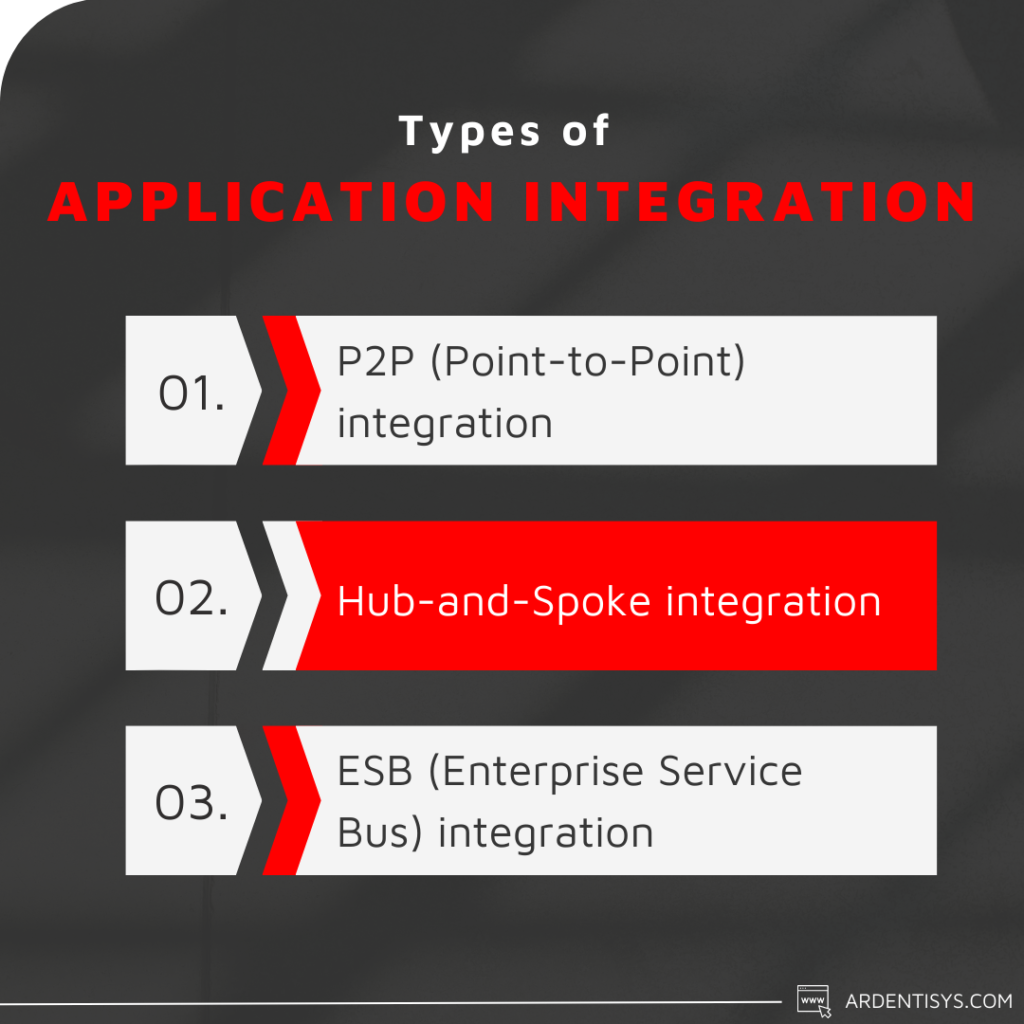
In this article, we will look at the three main application integration approaches including Point-to-Point, Hub-and-Spoke and Enterprise Service Bus so you can choose the right approach for your business and requirements.
P2P (Point-to-Point) integration
The P2P integration enables you to connect two or more apps with the code, this code can be written in multiple languages to create an increasing number of integrations as and when you need them. The P2P approach adopts middleware technologies such as APIs to exchange data between the apps being integrated. Here are some key benefits and limitations to consider if you are looking at leveraging P2P for your next app integration project:
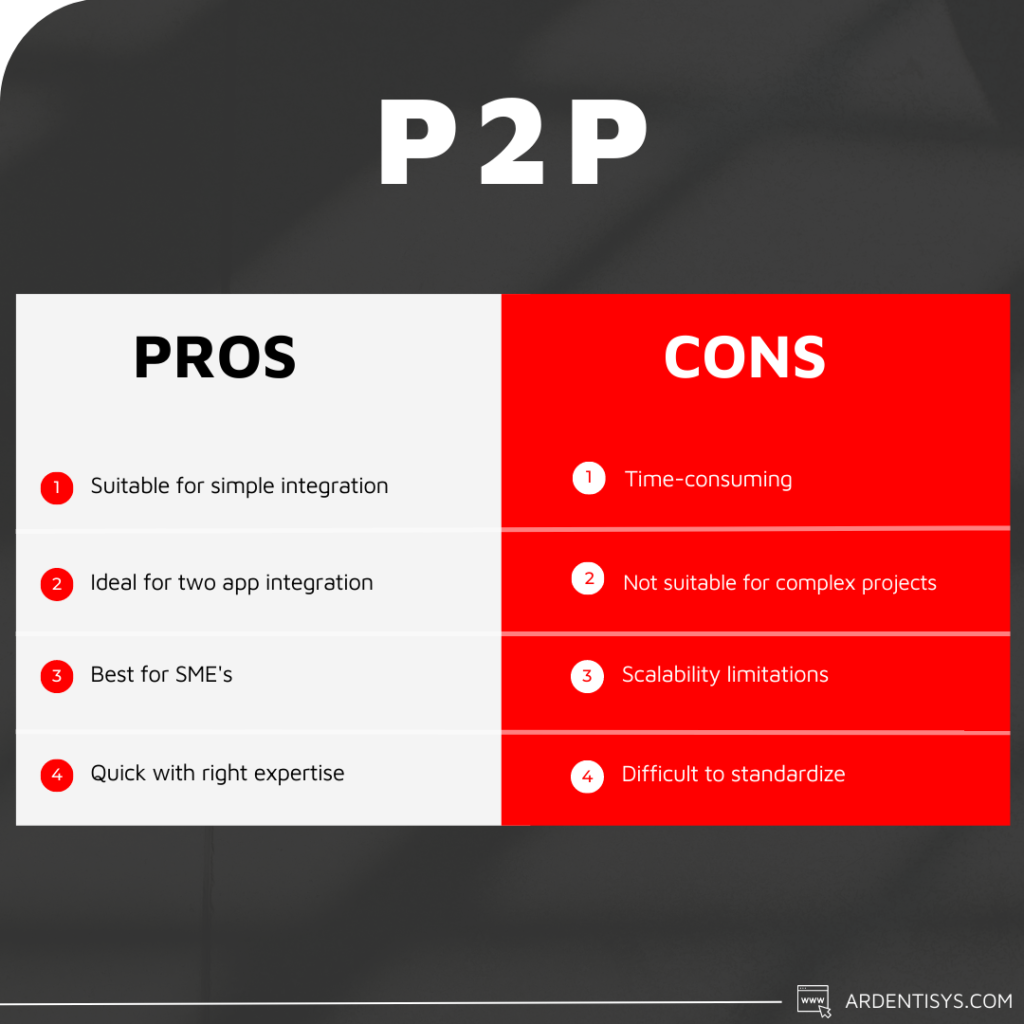
Benefits of P2P integration
- Suitable for shallow, simple integrations
- Ideal if you are only connecting two apps
- Good for businesses starting out or SMEs
- Can be implemented quickly with the right skills and expertise
Limitations of P2P integrations
- Time-consuming
- May not be suitable for complex integration
- Limitations of scalability
- Costly as the number of integrations increase
- Difficult to enforce a standard
Hub-and-Spoke integration
The Hub-and-Spoke model of integration was the answer to the limitations that the P2P method presented. This model created a centralized hub that has all the applications integrated with it through adapters which are known as Spokes. The hub itself is the MOM (Message Orientated Middleware) which decides how and where the data is shared. Here are some benefits and limitations of hub-and-Spoke to consider:
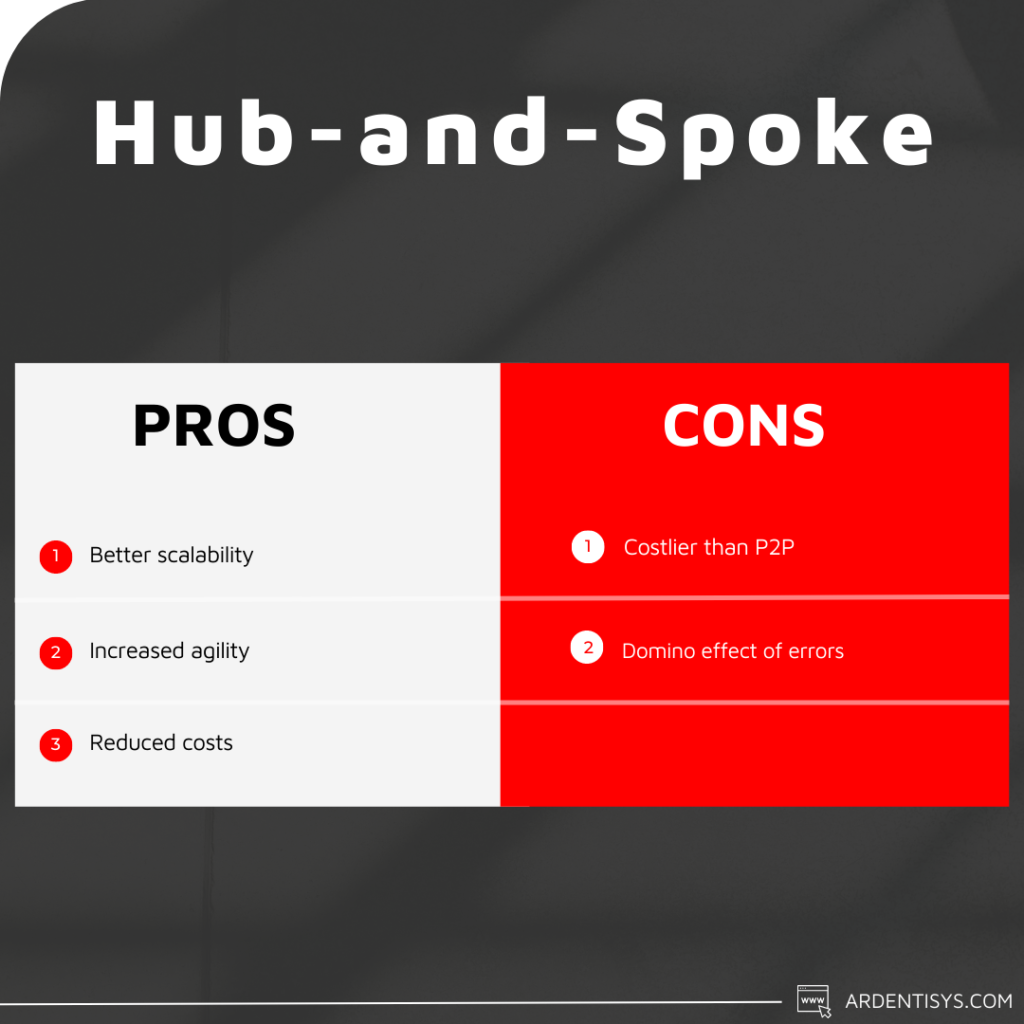
Benefits of Hub-and-Spoke integration
- Enables better scalability than P2P with a simplified architecture
- Increases agility enabling you to adapt and evolve to meet the everchanging business demands
- Reduces costs of integration
Limitations of Hub-and-Spoke integration
- Can be costly compared to P2P and requires an initial investment for the setup of architecture
- One system error may impact the entire ecosystem of apps
ESB (Enterprise Service Bus) integration
The ESB model for app integration uses a central bus which enables the app to communicate with each other without dependency. The ESB is an agile approach to integration and is an alternative to the limitations that come from P2P integrations. The applications are decoupled and can communicate with the use of an adaptor. Here are the benefits and limitations of ESB that you need to consider before adopting this model for app integration.
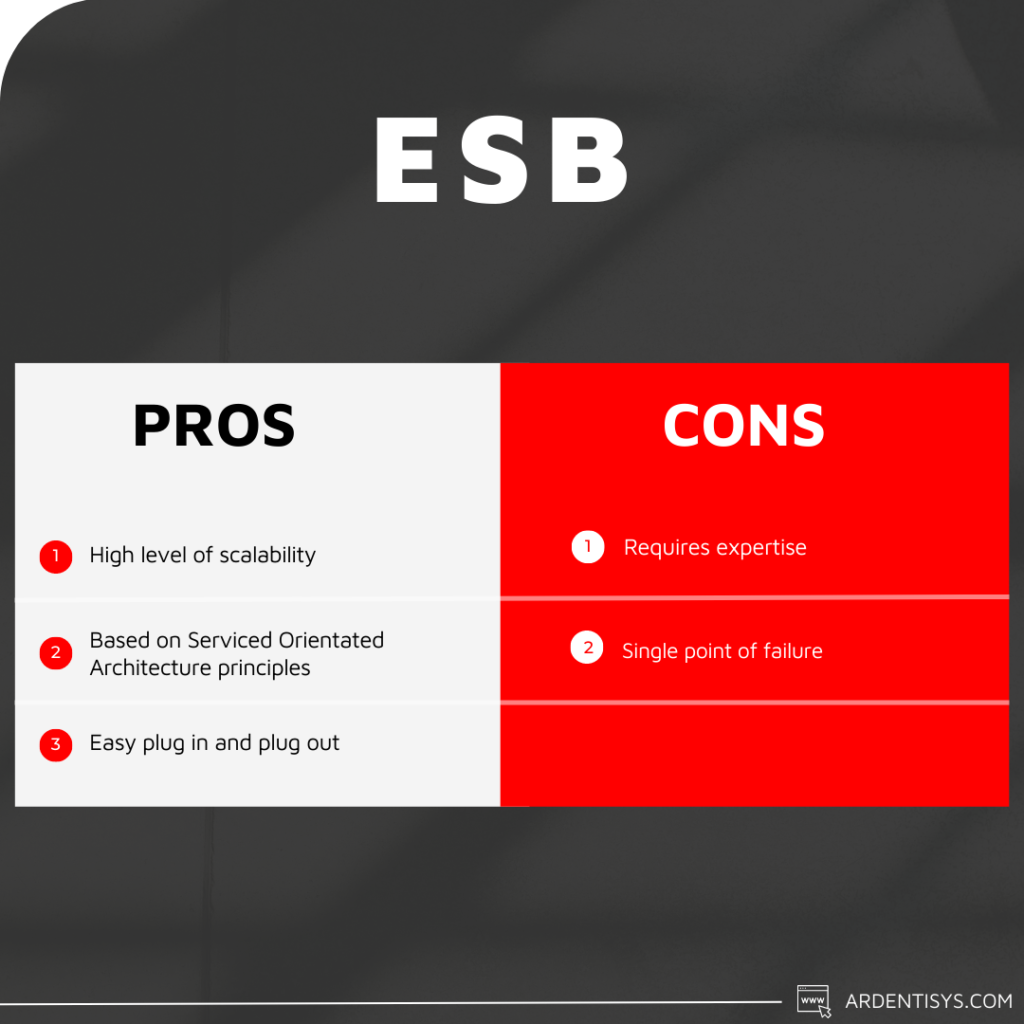
Benefits of ESB integration
- Based on Service Orientated Architecture principles
- High level of scalability due to the ability to add and integrate multiple apps as businesses grow and evolve
- Easily plug and plug out apps with decoupling based on business requirements
Limitations of ESB integration
- Will require expertise and skill to build and maintain
- Single point of failure as all apps are routed through one centralised location
Ardent app integration services
Choosing the right application integration approach for your organisation will depend on your unique business needs and requirements. If you are unsure about which approach is right for you, Ardent's highly skilled app integration experts can provide guidance on how to best solve your challenges with the right type of app integration for you. If you are looking to outsource your application integration services to uncover business insights, improve productivity and increase efficiencies, we can help. Discover our client success stories to find out how they are thriving with Ardent software solutions:
- A complete recruitment software product to get the job done
- Warehouse management automation user-friendly app
- Making logistics simple with fine art storage and preservation software
You tell us your challenges and we will find the right solution for you, get in touch to find out more or to get started.
Ardent Insights

Which Platforms Are Ahead in AI-Ready Data Pipelines?
At Ardent, we have spent years helping organisations design, modernise and operate the data foundations behind critical reporting, analytics and decision-making. That experience gives us a clear view of what now separates AI-ready businesses from those still struggling to get value from their data. It is not the amount of data they hold, or even [...]
Read More... from Application integration approaches – choosing the right one for your project
Making Your Existing Data Pipelines AI-Ready
From Stable Infrastructure to Adaptive Intelligence Most organisations do not need more data. They need their existing data to work better. At Ardent, we spend a significant amount of time inside large-scale client data platforms that are already mature, operational, and delivering value. These are not greenfield environments. They are complex ecosystems built over years, [...]
Read More... from Application integration approaches – choosing the right one for your project

AI-Powered ETL in Amazon Redshift
When the Warehouse Starts Doing the Work In our previous piece, we explored how ETL (Extract, Transform, and Load) is evolving into adaptive, intelligent systems. In Redshift environments, we are now seeing what that shift looks like in practice. For most of its life, Amazon Redshift has been treated as the final step in the [...]
Read More... from Application integration approaches – choosing the right one for your project

Services
About
UK
US
India

