Oracle to Redshift data migration and what you need to consider
21 September 2022 | Noor Khan


Migrating your data can be a complex and challenging process especially if you are dealing with large volumes of varied data. Therefore, it is vital to understand the key benefits and limitations of the destination platform of your data.
Hosting and making use of your data on a cloud service can make it much more accessible and provide extra security and functionality. More than likely your data will evolve and grow, therefore you may outgrow your existing data platform. In this article, we look at Oracle to Redshift data migration and what you need to consider.
What is the Oracle Cloud Infrastructure (OCI)?
Oracle is a public cloud platform, that has been developed to improve existing processes and to make data solutions more streamlined, functional, and accessible. The platform accelerates migrations of existing workloads and offers reliability and high performance.
Some of the services Oracle supports include: data migration, creating custom builds, developing new applications on the cloud, and running processes from existing workloads.
The pros and cons of using Oracle
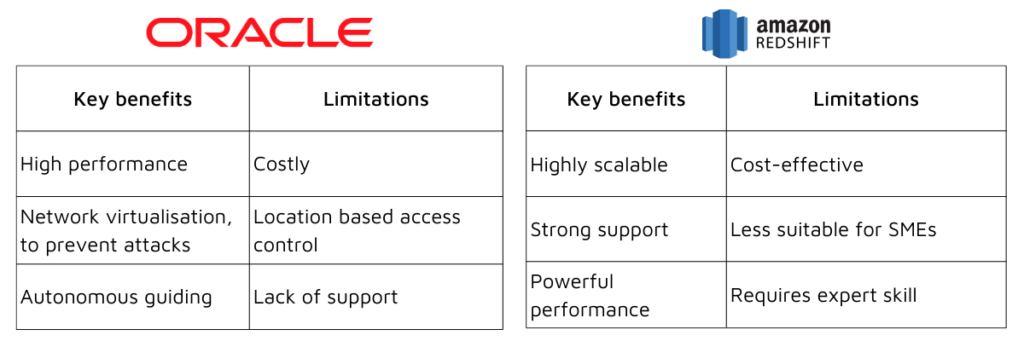
Oracle has tools to make the data migration process easier, such as the Oracle Data Pump, this utility allows for very high-speed movement from one Oracle DB to another.
The platform also offers isolated network virtualisation, to prevent attacks, and has a custom-designed SmartNIC.
The autonomous guiding has been designed to be user-friendly, with fast loading, and helpful hints provided.
However, location-based access control can cause issues, and there isn’t as much of a knowledge base for support, compared to other cloud services.
Choosing to work with AWS Redshift
Redshift is a cloud service offered by Amazon and is known for performance innovation, secure and reliable data warehouse storage, predictive insights, and scalable analytics.
Redshift offers fully managed petabyte-scale data warehouse space, and the service is often said to be fast, scalable, and cost-effective.
Ardent is a certified AWS partner, read more on what that means for you.
The pros and cons of using Redshift
Redshift is known for providing fast-scaling and robust security tools, with ease of use and accessibility – which is also supported by a large knowledge base and assistance.
However, users are required to understand the distribution and sort keys for indexing data, and it doesn’t work as a live app database.
When it comes to migrating the data, your internal systems have to send information to the system or utilise USB drives to an AWS shipper – which can affect the ability to send over data to be warehoused, especially for small businesses who have capped data usage.
Why migrate your data from Oracle to Redshift?
Data migration comes about from improving data storage and retrieval, upgrading functionality, gaining confidence in using technology, or simply outgrowing an existing cloud platform. These may be just some of the reasons you may opt to move your data from Oracle to Redshift. However, migrating your data from Oracle to Redshift will offer benefits including:
- Improve data query and data load performance
- Increase data scalability to future-proof your data
- Save costs significantly
What are the key differences between Oracle and Redshift?
Oracle and Redshift have fundamental differences in the way the platforms operate and how they store data.
- Redshift offers data blocks in much larger sizes, and the data is stored separately in columns – allowing for different forms of data compression.
- Oracle has a wide range of database features, which are not all available to use in Redshift, and some data types can not be used in the same format across the two services.
Basis of migrating your data
Determining the functionality you need, your preferred method of operation, and how you want to use your data, will largely inform your decision to use either service, and whether or not to migrate your data to the new platform.
Ardent data migration solutions
We have worked on multiple projects migrating data from one platform to another whether it’s Oracle to Redshift data migration, AWS to Azure, vice versa and much more. Ardent data migration solutions give you peace of mind knowing your data is being handled by experts who have decades of experience dealing with a wide variety and large volumes of data. If you are looking for a credible and reliable data engineering partner with a proven track record, Ardent can help. Explore our data engineering services or get in touch to unlock your data potential.
Ardent Insights

Which Platforms Are Ahead in AI-Ready Data Pipelines?
At Ardent, we have spent years helping organisations design, modernise and operate the data foundations behind critical reporting, analytics and decision-making. That experience gives us a clear view of what now separates AI-ready businesses from those still struggling to get value from their data. It is not the amount of data they hold, or even [...]
Read More... from Oracle to Redshift data migration and what you need to consider

Making Your Existing Data Pipelines AI-Ready
From Stable Infrastructure to Adaptive Intelligence Most organisations do not need more data. They need their existing data to work better. At Ardent, we spend a significant amount of time inside large-scale client data platforms that are already mature, operational, and delivering value. These are not greenfield environments. They are complex ecosystems built over years, [...]
Read More... from Oracle to Redshift data migration and what you need to consider
AI-Powered ETL in Amazon Redshift
When the Warehouse Starts Doing the Work In our previous piece, we explored how ETL (Extract, Transform, and Load) is evolving into adaptive, intelligent systems. In Redshift environments, we are now seeing what that shift looks like in practice. For most of its life, Amazon Redshift has been treated as the final step in the [...]
Read More... from Oracle to Redshift data migration and what you need to consider
Services
About
UK
US
India

