Microsoft Vs AWS Data Migration – what you need to know
9 September 2022 | Noor Khan


Data migration can offer multiple benefits to organisations however migrating data from one location to another, or changing its format, can be a complex task. It can be especially complicated if you are dealing with large volumes of varied data or if the content is sensitive.
Here, we are looking at Microsoft to AWS migration, the pros and cons of both, the differences between these data migration technologies, and what you should consider before migrating data between the two.
Migrating data with Microsoft - what does this tool actually do?
Data migration on Microsoft’s Azure is supported by their Data Migration Assistant (currently at v5.6). The tool is designed to allow upgrades to modern data platforms by detecting issues with compatibility (such as those that can impact database functionality on the new SQL Server), and then recommends performance and reliability improvements for the target environment.
The tool also allows the user to not only move schema and data but also uncontained objects from the source server to the target server.
The benefits and limitations of Microsoft data migration
The benefits include:
- Version updates fix established issues
- Recommends performance and reliability improvements
- Allows for the movement of ‘uncontained objects’ to the target server
- Compatibility issues are organised into breaking changes, behaviour changes and deprecated features.
There are some limitations to consider:
- Not suitable for larger migrations (the Azure Database Migration Service is recommended by Microsoft instead)
- Requires downloading and installing the tool
- To run an assessment, you have to be a member of the SQL Server sysadmin role
Ardent is a Microsoft Gold Certified Partner, find out what it means for you.
Migrating data with AWS
Amazon’s AWS Database Migration Service allows for quick migration of databases, with minimal downtime for the applications that rely on the database. The service allows for data to be migrated to and from the most widely used and open-source databases.
The platform can be simple to use, with no need to install any drivers or applications – and it does not require changes to the source database. The Database Migration Service (DMS) tasks can either be one-time migration or set for ongoing replication.
The AWS DMS continually monitors source and target databases, network connectivity, and the replication instance, and should the process be interrupted, it will automatically restart and continue from the point where it stopped.
Benefits and limitations of AWS migration
Benefits include:
- Allows for homogeneous database migrations (where the source and target database engines are the same or compatible)
- Allows for continuous data replication
- Self-healing service that restarts from point of interruption
Limitations to consider:
- Inadequate resources allocated can cause migration tasks to run slowly
- Does not usually do schema or code conversion
- Can slow down source systems with large database migrations
Ardent is a certified AWS partner - find out what it means for you.
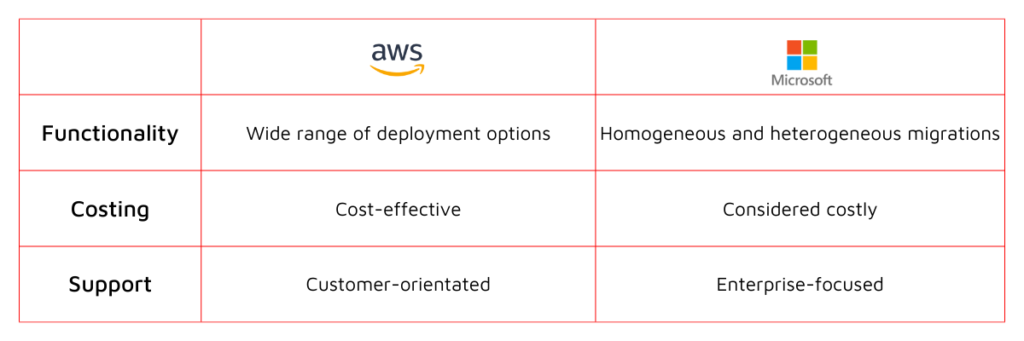
The key differences between Microsoft AWS for data migration
Functionality
Both services offer a range of options and functionality, but Microsoft (especially with the Azure platform) can offer a wider range of deployment options. AWS has better support for migrations that could be interrupted and offers both homogeneous and heterogeneous migrations.
Costing
Microsoft (through Azure) is often cited as being cheaper than AWS, and it is claimed that the program offers better cloud compliance with Windows.
Support
Both Microsoft and AWS are leading technology brands, therefore they do provide knowledge bases, tools, and varying levels of support for users, which goes in-depth into the ins and outs of the platforms. However, AWS is considered to be more customer-orientated, whereas Microsoft is seen as more enterprise-focused.
What to consider when migrating data between Microsoft and AWS
Before you make any changes to your cloud service, you should examine what your specific needs are – this includes technical, operational, and financial.
- Microsoft is often discussed as having a smoother interface, but AWS is known for better provisioning and more instances.
- AWS has a pricing model that allows for hourly charging, whereas Microsoft (under Azure) is chargeable per minute.
- For the actual data migration, Microsoft’s services are often considered easier to use (especially for existing Microsoft users) and use a PaaS model to make migration easier.
- Both platforms offer support for migrating data (Microsoft to AWS, and AWS to Microsoft), with tools and automation available.
The choice of platform will largely come down to your own needs, competence levels with the software involved, and your budget. We recommend that you carefully evaluate both services, what they offer (compared to what you need), and how comfortable you are with the tools and interfaces, and determine whether your needs (and your budget) best match the service you use. Alternatively, you may want to outsource your data migration solution to a credible, experienced data engineering services provider.
Ardent data migration solutions
Ardent has worked with a wide variety of clients delivering data migration solutions with minimal disruption to the day-to-day whilst ensuring industry best data security practices. If you have an upcoming data migration project, whether that’s to improve efficiencies, save long-term costs or improve data security, Ardent can help. We make recommendations based on over a decade of experience or work with your preferred technologies to deliver a data migration solution to suit your unique needs.
Explore our data engineering services or get in touch to find out more.
Ardent Insights

Which Platforms Are Ahead in AI-Ready Data Pipelines?
At Ardent, we have spent years helping organisations design, modernise and operate the data foundations behind critical reporting, analytics and decision-making. That experience gives us a clear view of what now separates AI-ready businesses from those still struggling to get value from their data. It is not the amount of data they hold, or even [...]
Read More... from Microsoft Vs AWS Data Migration – what you need to know

Making Your Existing Data Pipelines AI-Ready
From Stable Infrastructure to Adaptive Intelligence Most organisations do not need more data. They need their existing data to work better. At Ardent, we spend a significant amount of time inside large-scale client data platforms that are already mature, operational, and delivering value. These are not greenfield environments. They are complex ecosystems built over years, [...]
Read More... from Microsoft Vs AWS Data Migration – what you need to know
AI-Powered ETL in Amazon Redshift
When the Warehouse Starts Doing the Work In our previous piece, we explored how ETL (Extract, Transform, and Load) is evolving into adaptive, intelligent systems. In Redshift environments, we are now seeing what that shift looks like in practice. For most of its life, Amazon Redshift has been treated as the final step in the [...]
Read More... from Microsoft Vs AWS Data Migration – what you need to know

Services
About
UK
US
India

