Data Management as a service (DMaaS) – A guide
25 January 2023 | Noor Khan


Data Management as a Service (DMaaS) is a cloud-based technology allowing companies to build and maintain data frameworks for their data needs – including receiving information, transforming data types, digging into (mining) the data, filing, and archiving, securing specific information, and transmitting information both internally and externally.
Data management is a business-critical process that:
- Minimises potential errors
- Generates effective processes
- Make reliably transmitted, up-to-date, and usable data accessible for various business purposes.
DMAAS can be used to functionally run the data management processes, it could also be used as a backup and recovery structure, or it may be designed to cover both areas.
The technology used in DMAAS
Primarily, Database Management Systems (DBMS) will act as an interface between the software and the controller, and then depending on the structure, setup, and coding language, the support tools and processes will be developed.
Choosing the right technology partners is an essential step in data management. Whether you are looking to create data pipelines and make use of data warehousing with AWS or Microsoft, require Open Source expertise, need to make use of DOMO, Databricks, or GoogleCloud, or have a new project that needs creating from the ground up – you need to have the right structure and setup in place.
Once you have your systems in place, the software choice is the next important step – this may require the creation of apps or handling data in various formats depending on the data engineering service being utilised – such as Python, Amazon Redshift, or MongoDB.
The pros and cons of DMAAS
Without the right sort of software and organisation in place, the many benefits of having access to data can be lost, especially if a company needs to make use of data on a daily basis and needs help managing everything from the volume in the database to the way in which it functions.
DMAAS is an operational undertaking (you need to have the right tools, programs, and functionality in place), but it is one that requires strategic thought – there are a lot of areas that you need to address, understand, and streamline, in order for the process to function smoothly and effectively.
In order to make strategic and intelligent decisions, you need to look at the pros and cons involved first:
The pros and cons of DMAAS
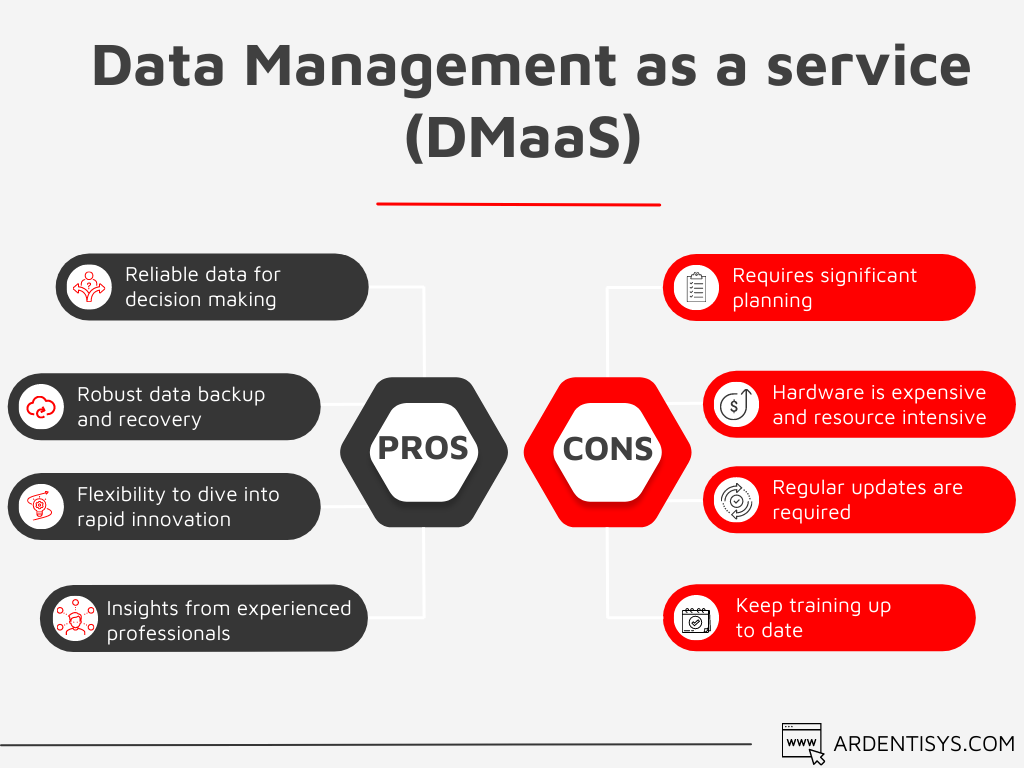
When you handle your DMAAS efficiently, whether that is with your own internal team or experts, when the processes and procedures are carried out, there are some significant benefits.
- Having reliable data makes decision-making simpler - Trusted data is something that makes a huge difference in the way your team operate, and the confidence your company can have in driving BI.
- Backup and recovery means getting back to work after an incident is faster - The right DMaaS systems will have been selected for your business needs, and that more than likely means that you will have substantial backups and disaster prevention in place – this means that you can not only protect your data in case of disaster but get back online and functioning quickly afterwards as well.
- Making use of cutting-edge technology allows for rapid innovation - DMAAS is a constantly growing and evolving discipline, which means that your company can stay flexible and benefit from fast-moving technologies or highly efficient new processes.
- Professionals bring the benefit of their experience - When you work with a team of professionals, who are constantly evaluating their services, you also benefit from new innovations and cutting-edge response times.
The following are some of the cons of DMAAS
- Costs must be planned for at every stage - DMaaS can be costly, especially if you have not optimised your processes yet, or are operating on outdated methods. Everything involved in DMaaS has a cost – whether that is time, money, or resources – so you need to be fully prepared for what is required, and how your budget will be impacted.
- Hardware can be expensive and resource intensive - Hardware can take up a lot of space, and although many services offer cloud-based solutions, it is not unheard of for companies to decide to purchase their own offline servers and data storage, for added backup and ease of usage in situations where recovery or rebooting is required. Deciding whether to spend on the technology and the space, rather than using a cloud service can be considered quite a drawback as you are needing to use a lot of space and funds for the project.
- Tools and programs must be updated regularly - Technologies involved in DMaaS is subject to updates, changes, and even replacements – and if you are handling all of this yourself, then you need to be sure of what you are using, when it should be used, and whether there are any updates available that will impact the work.
This issue is less of a problem when you work with a team of skilled Data Engineers, as they are familiar with the programs, have the tools and updates to hand, and know where to look to ensure they are using the most up-to-date software and processes - Training and qualifications of team members must be kept up-to-date - Staff and skillset, when handling DMaaS internally, can also be an issue in the same vein – your team need to be fully trained, up-to-date, and prepared to handle situations and coding languages that they may not be completely familiar with. Bringing in an external team, who specialise in handling DMaaS, is often a far better use of a budget, as you are not just getting access to the manpower of the people doing the work but benefiting from the experience and expertise as well.
Seeking advice and discussing specific business needs for these processes is the recommended approach, in order to ascertain the best processes and technologies for your business. Once you have clear advice, a well-identified structure, and the right tools for the job, your DMaaS can start to work for you and your company.
Data management as a service with Ardent
Ardent provides data management as a service offering clients dealing with large volumes of complex data peace of mind. Your data will be handled by data experts who have decades of experience in data management. Our engineers are proficient in world-leading technologies and can ensure your data is secure, accessible and performing optimally. Get in touch to find out more or explore our data management services.
Ardent Insights

Which Platforms Are Ahead in AI-Ready Data Pipelines?
At Ardent, we have spent years helping organisations design, modernise and operate the data foundations behind critical reporting, analytics and decision-making. That experience gives us a clear view of what now separates AI-ready businesses from those still struggling to get value from their data. It is not the amount of data they hold, or even [...]
Read More... from Data Management as a service (DMaaS) – A guide
Making Your Existing Data Pipelines AI-Ready
From Stable Infrastructure to Adaptive Intelligence Most organisations do not need more data. They need their existing data to work better. At Ardent, we spend a significant amount of time inside large-scale client data platforms that are already mature, operational, and delivering value. These are not greenfield environments. They are complex ecosystems built over years, [...]
Read More... from Data Management as a service (DMaaS) – A guide
AI-Powered ETL in Amazon Redshift
When the Warehouse Starts Doing the Work In our previous piece, we explored how ETL (Extract, Transform, and Load) is evolving into adaptive, intelligent systems. In Redshift environments, we are now seeing what that shift looks like in practice. For most of its life, Amazon Redshift has been treated as the final step in the [...]
Read More... from Data Management as a service (DMaaS) – A guide
Services
About
UK
US
India

