Cross-Platform Vs Native Mobile Apps – Selecting the right mobile app development approach
19 May 2022 | Noor Khan



Whether you are building your mobile app in-house or are outsourcing to a software development provider, you will need to ensure that you are choosing the right framework and mobile app technologies suited to your requirements. According to Statista, although cross-platform technologies are becoming popular with Flutter being the most popular cross-platform technology, only a third of developers in 2021 used cross-platform technologies to build mobile apps.
At Ardent, our mobile app developers have worked on a vast variety of mobile app technologies to build innovative, secure and cutting edge mobile apps to meet the needs of our clients. Therefore, we understand how important it is to get the technology right. Our engineers recommend you carry out research and get advice from experts as choosing the framework will have long term impact in terms of the costs, the time required and the functionality of the app. Here we will explore both cross-platform and native app development frameworks in terms of the benefits they offer and the limitations they have.
Cross-platform mobile app development framework
Cross-platform mobile apps have a single base code that is used across different platforms such as Android and iOS to build the app. Cross-platform apps have become increasingly popular as they allow businesses to save both time and costs during the development process. However, as the code is used across all platforms the apps may not perform and function at the optimal level as their Native counterpart. This type of framework can be game-changing for businesses that are looking for a speedy go-to-market, especially startups.
The pros and cons of cross-platform mobile apps
- There are a number of pros to consider for cross-platforms and they are:
- Reduced development time
- Save costs due to the less time and resources required to build the app
- Speed up go to market
- Only one base code required enabling code reusability
- Hassle-free integration
On the other hand, there are a few cons to consider and they are:
- Limited functionality due to the same code being used across platforms
- May perform slower due to the abstraction layer
- UX (User experience) may be affected as you can not tailor it to each platform
- Lack of flexibility in customisation
When you should consider a cross-platform app
It may be the case that a cross-platform framework may be a better fit for your app in certain situations and they are:
- If you are looking for a speedy development process
- If you are looking to target users on key OS (Operating system) such as Android and iOS
- You are building an app that is not complex and does not require platform-specific features and customisation
- You have a limited budget and time constraints
Cross-platform mobile app development technologies
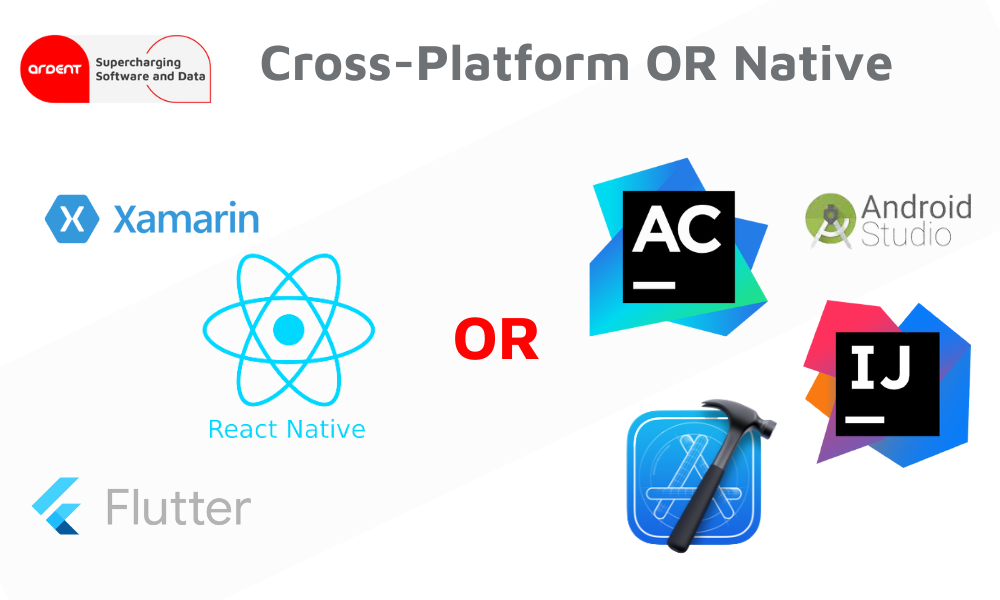
Several technologies have enabled the success and popularity of cross platforms and they include React Native, Xamarin and Flutter. Ardent’s software engineers have worked with a variety of these technologies to develop cross-platform apps for clients.
Read our success story on a cross-platform app we have built for a market research client.
Native mobile development framework
Native mobile apps are apps that are built specifically for one operating system. Developers use platform-specific tools and programming languages to build these apps. For example, to build an app for the Android platform, developers may use Android Studios whereas for iOS they may opt for XCode. Native mobile apps are still by far the most popular due to the number of benefits they offer.
The pros and cons of native mobile apps
- Native apps offer several benefits and they include:
- Improved and overall better UX due to the apps being built for specific platforms
- High performance
- Highly scalable
- Platform-specific technologies offer broader functionalities
Some cons to consider are:
- Time-consuming and longer development time
- Requires more resources than cross-platform apps
- Higher costs due to time and resources needed
- High maintenance
When you should consider a native app
A native app framework may be the better fit for your business, project. Here is when you should consider a native app for your business:
- You require advanced functionality
- You want to provide seamless UX
- You are not limited by budget or time
- If you are looking to scale your app up or down
Native mobile app development technologies
The most popular native mobile app development technologies are those that are specific for Android and iOS. For Android, it is the likes of Android Studio or IntelliJ IDEA, whereas for iOS it's mainly XCode and AppCode. Some of the biggest mobile apps in the world are built on the native framework and they include the likes of Google Maps and Spotify.
Cross-platform VS native mobile apps
Overall there are clear benefits of both types of frameworks for mobile app development. When deciding between cross-platform or native mobile apps there are a number of factors to consider and they include, budgets, times, maintenance, resources, long term costs, user experience, functionality and flexibility.
Ardent’s mobile apps
Ardent’s experienced mobile developers have worked on several projects building both native and cross-platform apps. If you require advice about which platform will be most suitable for your business, then get in touch and we can help you navigate your journey to creating a great mobile app.
Ardent Insights

Which Platforms Are Ahead in AI-Ready Data Pipelines?
At Ardent, we have spent years helping organisations design, modernise and operate the data foundations behind critical reporting, analytics and decision-making. That experience gives us a clear view of what now separates AI-ready businesses from those still struggling to get value from their data. It is not the amount of data they hold, or even [...]

Making Your Existing Data Pipelines AI-Ready
From Stable Infrastructure to Adaptive Intelligence Most organisations do not need more data. They need their existing data to work better. At Ardent, we spend a significant amount of time inside large-scale client data platforms that are already mature, operational, and delivering value. These are not greenfield environments. They are complex ecosystems built over years, [...]
AI-Powered ETL in Amazon Redshift
When the Warehouse Starts Doing the Work In our previous piece, we explored how ETL (Extract, Transform, and Load) is evolving into adaptive, intelligent systems. In Redshift environments, we are now seeing what that shift looks like in practice. For most of its life, Amazon Redshift has been treated as the final step in the [...]
Services
About
UK
US
India

