Comparing leading data warehousing technologies
22 March 2023 | Noor Khan


Big data plays a huge role in several businesses, to the point where 79% of companies fear that not using it would help bankrupt them, and 86% believe that big data will revolutionise the way they do business.
To fully utilise big data, and any data sets effectively, you need to have a reliable place to store it, and the right technology partners. There are different solutions available, and one of the most popular is making use of cloud data warehousing technologies, which allow companies to store and use their data, without the cost and requirements of setting up servers of their own.
We will compare leading data warehousing technologies on the market, each with thier own pros and cons, and ways of operating including Amazon Redshift, Databricks, Google Big Query, Snowflake and Azure Synapse.
Amazon Redshift - pros and cons
Part of the Amazon Web Services (AWS) system, Redshift provides analytical tools, data management, and processing on a cloud-based server. Known for its scalable services, and ability to cope with large amounts of data, it is often a popular choice and is used by more than 11,000 companies across the world.
Some of the benefits offered by Redshift include:
- High levels of security – including network isolation, end-to-end encryption, and fault tolerance
- Efficient storage – with high-performance processing, zone maps, columnar storage, and effective data compression
- Extensive support – including a large knowledge base, guides, and support functions
- High-performance query processing – with resources and platforms that support the functions, and centralised data structures for time-efficiency
Some of the difficulties that come with the Redshift platform include:
- Redshift is not a multi-cloud platform
- Payment is dependent on usage and can significantly increase the cost
- It is not a serverless architecture
Amazon Redshift use case
Managing 4 petabytes of client data for a leading consumer electronics brand with Amazon Redshift. Read the full story here:
Databricks – pros and cons
A data analytic and data engineering tool which commands a significant market share in the big data analytic area (11.87%), Databricks is a leading data engineering tool with flexible programming and large load capability.
Some of the key benefits of Databricks include:
- Flexibility in processing – with the cloud environment supporting Spark R, SQL, Python or Scala
- Aggregation of datasets in the cloud – with the option for in-line visualisations and organised structure through the notebook format
- Supported by significant knowledge bases – including guides, tutorials, documentation, and user interactions
Some of the cons of the Databricks include:
- Less comprehensive selection of tools
- CPU optimisation is not as well performing as some other platforms
- Data backup feature is not consistently reliable
- Users need a certain experience level and knowledge to utilise effectively
Databricks use case
A global media and broadcasting company monetize their broadcasting data with Databricks for trusted and timely data availablility for real-time, mission-critical data. Read the full story here:

Improving data turnaround by 80% for a Fortune 500 company with Databricks as the technology of choice. Read the full story here:
Google Big Query – pros and cons
Part of the Google Cloud services platform, Big Query allows for processing, storage, and analytics, as well as providing options for machine learning. Used by a number of large organisations across the world, the platform is considered to be an inexpensive data option.
Key benefits of using Google Big Query for data warehousing:
- Intuitive interface – which is relatively easy to use with minimal experience, and allows for easy builds of new queries
- Data is automatically optimised – When fetching data, the platform automatically optimises the query to reduce time wastage
- Effective across multiple databases – The tools allow for efficient management and access to different databases
Cons that have been highlighted with Big Query:
- Cannot be used as a substitute relational database
- Orientated for analytical queries and not simple operations
- Requires unique SQL implementation for querying data.
Snowflake - pros and cons
Snowflake holds the largest share of the data warehousing industry (19.5%) and is used by over 36,000 companies. Highly scalable, and structured for supporting structured and semi-structured data, the service has no limits on computing or storage.
Some of the key benefits of the Snowflake :
- Fast and flexible options – The data storage, processing and analysis are easy-to-use and designed with a new SQL query engine
- Cloud-agnostic – The service works with AWS, Google Cloud, and Microsoft Azure
- Multiple data workloads can scale independently – this allows effective management, engineering, and data sharing
- Architecture scales as required – Due to the unique build of the platform, Snowflake can scale up and down based on requirements and workloads.
Cons of Snowflake:
- Not as cost-effective as some competitors
- Designed to be run on the public cloud, and only recently (2022) expanded to on-premises storage
- Small support community when compared to others
Azure Synapse analytics – pros and cons
An analytic service which combines data integration and data warehousing services with big data analytics, Azure Synapse is a Microsoft platform supported by a wide range of complementary services and tools.
Some of the key benefits of using Azure include:
- Combined functionality – Utilising the functions from Azure Data Factory, Storage, SQL Server, and Azure Databricks, the platform is easy to use for those that have already been experienced with working with Azure services.
- End-to-End solutions can be created in one window – Because Azure Synapse integrates functions from different tools, work can be done in one window for faster and easier development.
- Provides options for serverless SQL – This is especially useful for smaller datasets and can help to connect other services by acting as a serving layer.
Some of the disadvantages of using Synapse:
- Inability to scroll through notebook cells
- Renaming notebooks is not straightforward
- The Spark clusters used for running notebooks are not accessible outside of Synapse
Leading data warehousing technologies - how to choose the right one
To determine the best data warehouse solution, you need to evaluate your own business needs – what you are currently aiming to achieve, where you will be taking your data in the future (and how you will scale this), and what skills your existing team are working with.
You may choose to work remotely with experienced third-party managed services, but you still need to have the right tools in place to ensure they can get on with their work efficiently and effectively.
When evaluating your needs, you should, at a minimum, consider:
- Employee skillsets
- Future developments
- Costs
- Scalability
Once you know what you want to do with your data, you will have a better idea of the tools that you will need to provide that functionality.
Ardent data warehousing services
At Ardent, we have leveraged powerful technologies to deliver secure, robust and scalable data warehouses to our clients to meet their unique needs and requirements. With our data warehousing service, we take a consultative approach to understanding your challenges, your growth plans, and future developments to handpick the technologies we think are the most suitable. If you are looking to build a data warehouse which enables you to:
- Effectively manage large, complex data
- Make your data accessible and secure
- Gain insights to driver better-informed decisions
Get in touch to find out more about how we can together, unlock the potential of your data.
Ardent Insights

Which Platforms Are Ahead in AI-Ready Data Pipelines?
At Ardent, we have spent years helping organisations design, modernise and operate the data foundations behind critical reporting, analytics and decision-making. That experience gives us a clear view of what now separates AI-ready businesses from those still struggling to get value from their data. It is not the amount of data they hold, or even [...]
Read More... from Comparing leading data warehousing technologies

Making Your Existing Data Pipelines AI-Ready
From Stable Infrastructure to Adaptive Intelligence Most organisations do not need more data. They need their existing data to work better. At Ardent, we spend a significant amount of time inside large-scale client data platforms that are already mature, operational, and delivering value. These are not greenfield environments. They are complex ecosystems built over years, [...]
Read More... from Comparing leading data warehousing technologies
AI-Powered ETL in Amazon Redshift
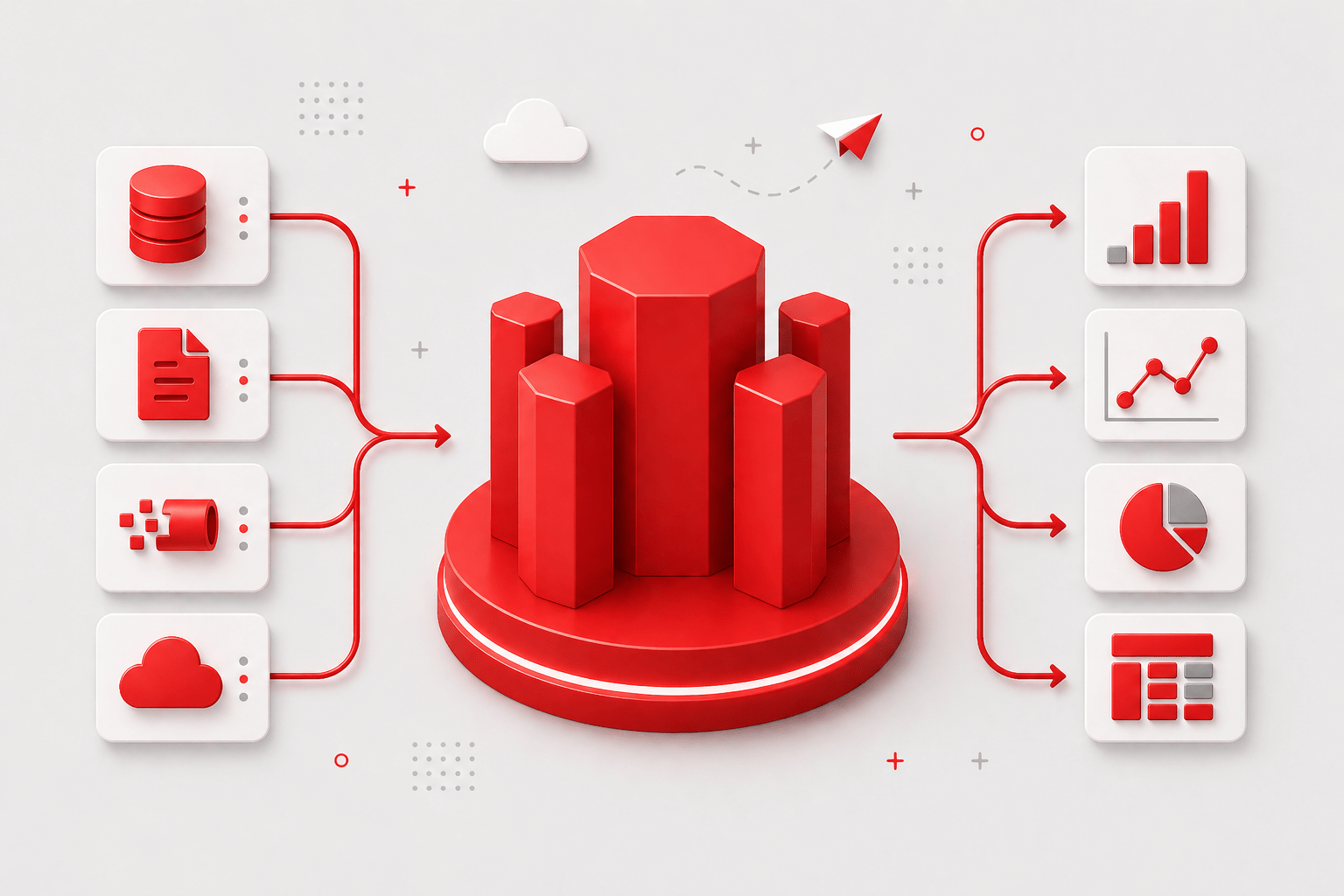
When the Warehouse Starts Doing the Work In our previous piece, we explored how ETL (Extract, Transform, and Load) is evolving into adaptive, intelligent systems. In Redshift environments, we are now seeing what that shift looks like in practice. For most of its life, Amazon Redshift has been treated as the final step in the [...]
Read More... from Comparing leading data warehousing technologies
Services
About
UK
US
India

