The six key stages of business process automation to consider
11 November 2022 | Noor Khan


Adopting business process automation can provide unmatched benefits to organisations across all industries and departments. The use of software to automate processes can help alleviate your teams from burdensome tasks, remove the room for human error and streamline your business operations to save time and costs. Gaining the benefits from business process automation is ensuring that your software is built right.
Getting started with business automation can be daunting. In this article, we will look at the key six stages of business process automation that can ensure your project is a success and provides long-term benefits.
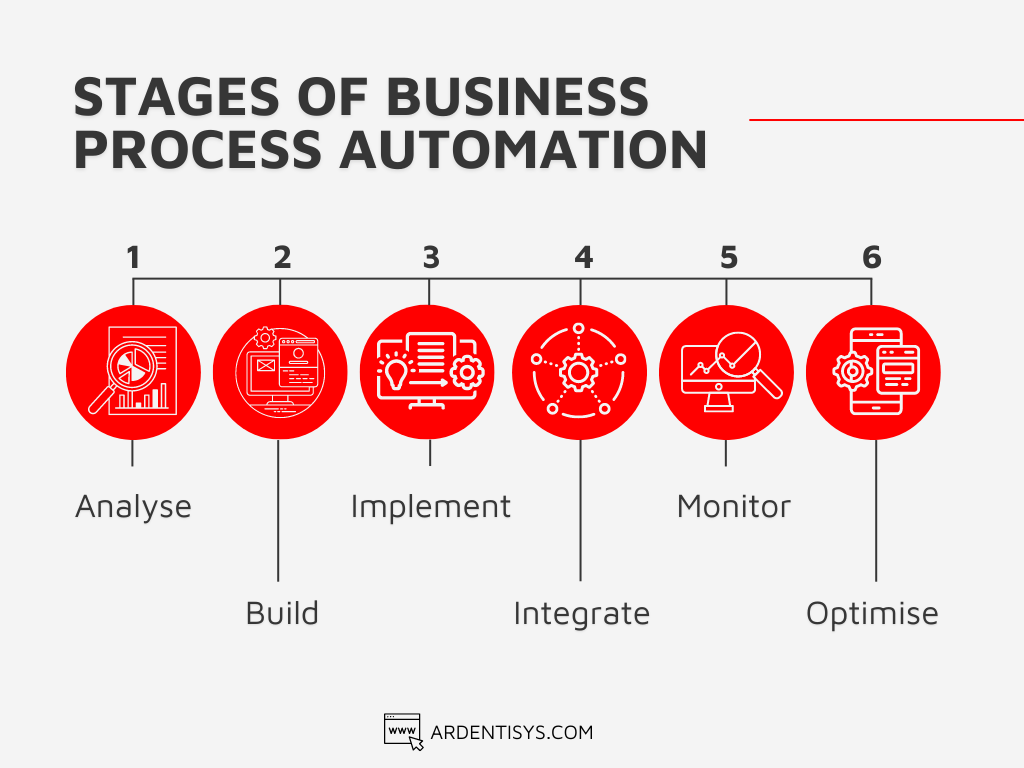
1. Analysis
Identifying manual processes
There are a wide variety of business processes across a number of departments, including sales, marketing and HR that can be automated. The first stage of your business process automation is the analysis of your processes and identifying and prioritising those that require automation first. For example, you may find that there are a lot of manual processes that need to be automated in Marketing but productivity levels are stills significantly higher than in HR. Therefore, you may shift your focus to automating HR processes.
Choose the right type of software
The second step in the analysis stage is to choose a software solution that you think would work best for your business automation project. This will depend on your software and technical knowledge, however, it may be useful to consider if your need just a web app or a mobile app, or if you need both. For example, if you are automating sales, you might want to have both a web app and a mobile app to ensure your teams can access the information in the software on the go.
However, if you do not have the expertise to determine this, then it’s best to just identify your challenges and the processes you want to automate.
2. Building
When it comes to building your business process automation software, you will have three main options:
- Building software in-house
- Outsourcing business process automation software development
- Hybrid of in-house and outsourcing software development
Building software in-house
If you have the skills, expertise and resource to build the software in-house, then this can be a great option as internally you are already aware of the way your software development team works. It’s important to create a project plan, and set realistic and achievable deadlines to ensure the project stays on track. Therefore, you will need to identify the software development team, the project managers and the key stakeholders. Additionally, ensuring all essential information is communicated to the relevant parties throughout.
Outsourcing business process automation
Another great alternative is to hire a software development company that can build the software you require with expertise. Outsourcing can significantly save you costs, in many ways from building software quickly and efficiently to speed up go to the market to being built with scalability in mind to reduce maintenance costs in the long term. Outsourcing enables you to access highly skilled developers, experience and expertise, leading technology platforms and much more. Therefore, this route is definably one you should consider.
A hybrid approach to building software
The hybrid approach to building software with an in-house and external team can be great for those organisations that may have a team in-house that have availability to work on the project but need additional resources. In this case, it is worth finding a company that can provide you with project-based extended teams to provide support and fill any skills gap.
3. Implementation
Once the software has been built and tested a number of times, it is time to start the implementation process. This can be a complex time for the project, as a lot can go wrong with unforeseen issues. Therefore, working together in collaboration with the software provider is key here. To ensure successful implementation there are many things you should consider:
- Communicate the implementation plan to all stakeholders
- Factor in time to deal with any potential issues that may arise with a risk assessment
- Create a timeline for the implementation, especially if it is a multi-step process
- Communicate go-live with everyone affected in the organisation
4. Integration
Once the business process automation software has been implemented, you may want to consider integration. For example, if you have implemented your sales automation software, you may want to integrate this with your billing and accounting software to ensure further collaboration in communication. This can offer further benefits to your teams and organisations. If you have worked with a third-party provider, then it is worth employing that resource are they will be familiar with your business process automation software. They may also make further suggestions that help improve your processes further.
5. Maintenance and support
Maintenance and support are key parts of any software development process. Any good provider should offer maintenance and support for a set period of time post-go-live. Depending on the level of support required, and the software implemented you may want to establish how long the maintenance and support are required. Additionally, you may want to work with teams who built your software on an ongoing basis to maintain and improve your software.
6. Review and optimise
The last key stage of business process automation is to review and optimise the software over time. This can go hand in hand with ongoing maintenance and support, where the teams that maintain your software ensure they are making suggestions to improve and optimise software, whether that is technically or functionally. For example, the Ardent software development team have worked on a client project for over a decade to help continuously improve and evolve the software.
Ardent business process automation software services
Ardent has worked with many organisations across industries to implement business process automation, from market research to logistics. If you are facing challenges with a low level of productivity, inefficiencies across departments, and human error, we can help. We will engage with you to understand your unique business challenges to build a solution that will help your business thrive with boosted productivity, improved efficiencies and removal of human error.
Ardent can help you at every stage:
- Analysis - You bring us your business challenges and we can help find you the right solution.
- Building - Our expert engineers will adopt leading technologies to build your business automation software that is agile, scalable and user-friendly.
- Implementation - Have peace of mind knowing that Ardent deliver projects in an organised structured fashion to make the process smooth.
- Integration - If you are looking to integrate your new software with existing systems or build two integrated new systems, we can help with our app integration services.
- Maintenance and support - We provide you with the support necessary so you can make the most out of your software.
- Review and optimise - Ardent have a proven track record of building long-term relationships, we can help you continuously innovate and optimise software to help you achieve your business goals and ambitions.
Get in touch to find out more or explore our business automation services.
Ardent Insights

Which Platforms Are Ahead in AI-Ready Data Pipelines?
At Ardent, we have spent years helping organisations design, modernise and operate the data foundations behind critical reporting, analytics and decision-making. That experience gives us a clear view of what now separates AI-ready businesses from those still struggling to get value from their data. It is not the amount of data they hold, or even [...]
Read More... from The six key stages of business process automation to consider

Making Your Existing Data Pipelines AI-Ready
From Stable Infrastructure to Adaptive Intelligence Most organisations do not need more data. They need their existing data to work better. At Ardent, we spend a significant amount of time inside large-scale client data platforms that are already mature, operational, and delivering value. These are not greenfield environments. They are complex ecosystems built over years, [...]
Read More... from The six key stages of business process automation to consider
AI-Powered ETL in Amazon Redshift
When the Warehouse Starts Doing the Work In our previous piece, we explored how ETL (Extract, Transform, and Load) is evolving into adaptive, intelligent systems. In Redshift environments, we are now seeing what that shift looks like in practice. For most of its life, Amazon Redshift has been treated as the final step in the [...]
Read More... from The six key stages of business process automation to consider

Services
About
UK
US
India

