The four types of database management systems
28 December 2022 | Noor Khan


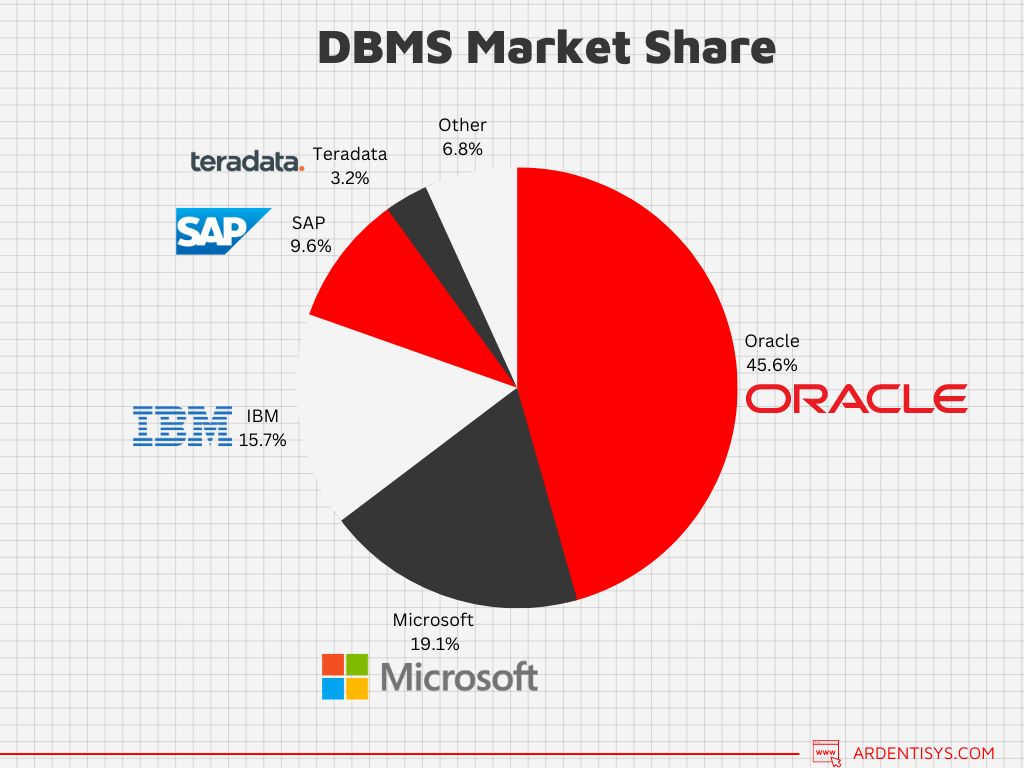
A database management system (DBMS) is a data-keeping system which organises your data, making it easily accessible and providing more control to the user. It serves as an interface for the user to access the data stored in the database. With a DBMS, the user can store, retrieve, and query the data stored in a database. The DBMS market has offerings from some of the leading technology brands in the world including Oracle (45.6%), Microsoft (19.10%) and IBM (15.70%) as highlighted by Info Clutch.
In this article, we will look at the four types of database management systems (DBMS) and how they differ.
What is a relational database management system?
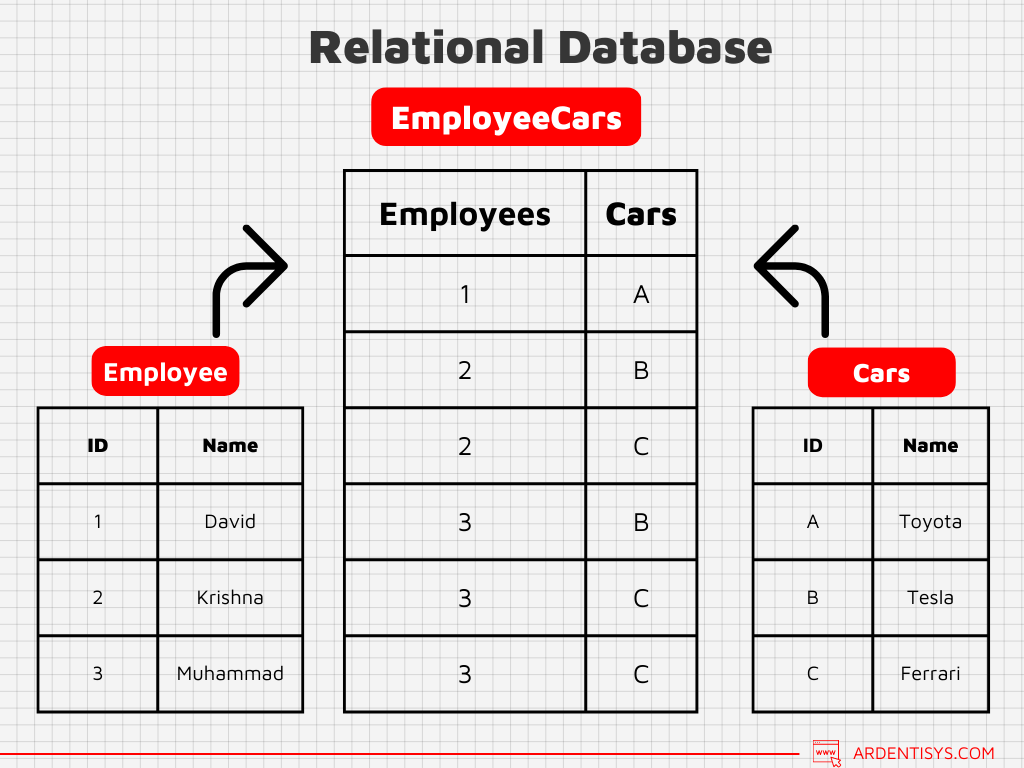
A relational database management system (RDBMS) is one of the most popular due to its flexibility and ease of implementation. An RDBMS stores data in a row-based table structure which connects the relevant data elements. We will look at some of the key benefits and limitations of an RDBMS.
The key benefits of an RDBMS
- Easy to use – This is due to the natural structure of the tables used
- Use of SQL to query the data – which is commonly used and is similar to natural language adding to the ease of use
- Data access – RDBMS enables users to easily access their data
- Multi-access – A RDBMS can be accessed by multiple users which is not possible for some other types of DBMS
- Access control – The admin can limit and grant access to the data which improves data security.
The limitations of an RDBMS
- Performance – The speed and performance can be slower than other DBMSs when it comes to querying the data.
- Costly – Set up and maintenance can be costly compared to others.
- Memory optimisation – as the RDBMS uses a table and column structure it uses a lot of memory which may mean extra costs for larger volumes of data.
Relational database management system technologies
Some of the leading technology brands make use of the relational database management structure and they include:
- Microsoft
- IBM
- MySQL
- PostgreSQL
- Oracle
What is an object-oriented database management system?
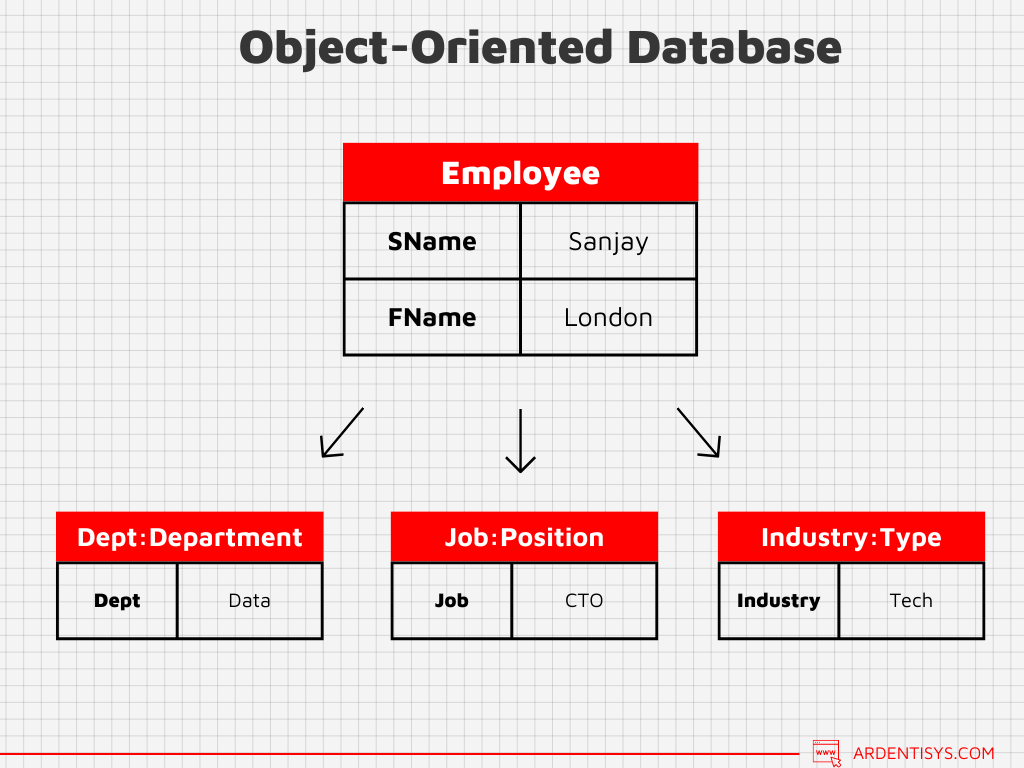
An object-oriented database management system (OODBMS) that maintains data as objects. OODBM is suitable for complex data as the data can be stored as objects, an alternative to RDBMS where it’s stored in tables and columns. This type of DBMS can work with several programming languages such as Python, Java, .Net and more.
The benefit of an object-oriented database management system
- Data storage – Can store a wide variety of data which can be much more complex compared to other types of DBMS
- Data access – Data can be retrieved quickly and easily.
- Variety of programming languages – A variety of programming can be employed including commonly used Python, Java and .NET
The limitations of an object-oriented database management system,
- Adoption – Compared to other DBMS, OODBMS are not widely adopted
- Highly complex – Considered to be quite complex as you are dealing with complex data
- Performance issues – This can be down to the higher level of complexity, where expert skills are required for optimisation
Object-oriented database management technologies
Some of the leading technologies used for OODBMS are the programming languages listed including:
- GemStone
- ObjectDB
- ObjectDatabase++
- Versant
What is a hierarchical database management system?
A hierarchical database management system structure stores data in a hierarchy, which mirrors a tree-like structure in the form of records. This type of structure has the root directory and subsidiaries which are connected to it via links. This is commonly referred to as parent and child nodes where a parent (root) can have one or multiple child nodes (subsidiaries).
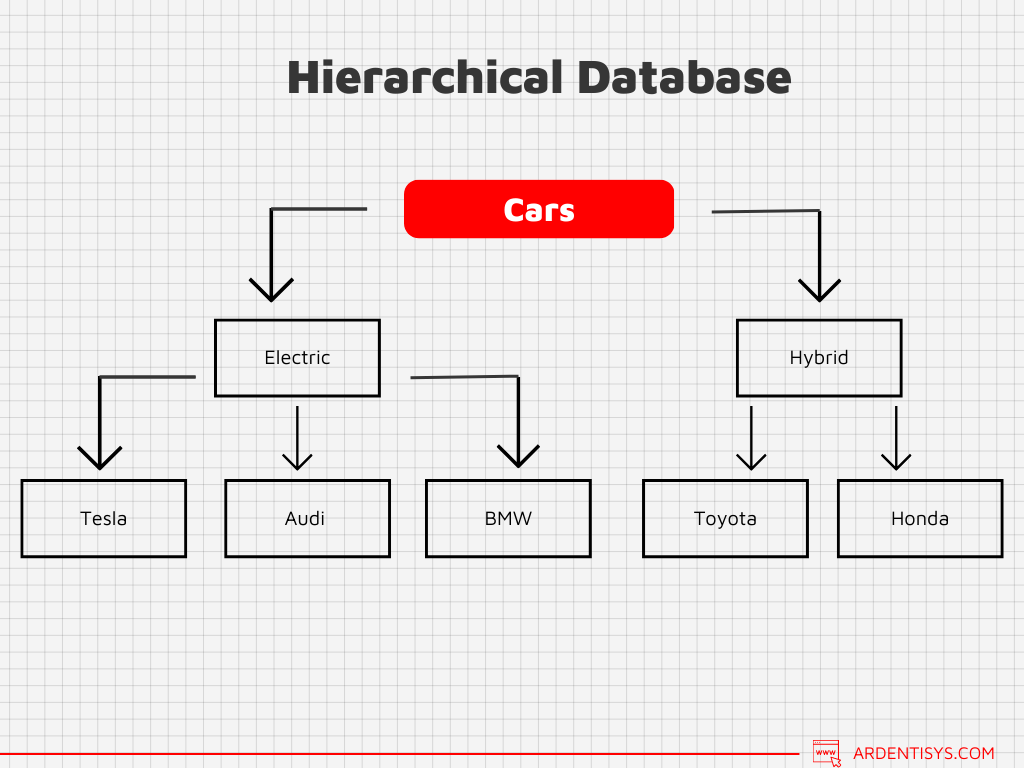
Key benefits of the hierarchical database management system
- Simplicity – compared to other structures this one is perhaps the easiest and simplest to understand.
- Speed – Each record has one parent, therefore navigating through the entire database is quick.
Limitations of a hierarchical database management system
- Lack of flexibility – there is no flexibility as the structure is quite rigid with the parent and child nodes and not all data is always hierarchical.
- Duplication – As a child can only have one parent, the data on the child may have to be reintroduced if it requires another parent.
Hierarchical database management system technologies
There are many leading technologies which offer a hierarchical database management system and they include:
- IBMs – Information Management System
- Windows – Registry
- XML data storage
What is a network database management system?
The network database management system is based on a network data model and is similar to a hierarchical structure with there being two main types of records, member and owner. However, as an answer to the rigidness of a network database management system a member can be linked to multiple owners and owners can be linked to multiple members. The visual of a network database management system is a net or an upside-down tree.
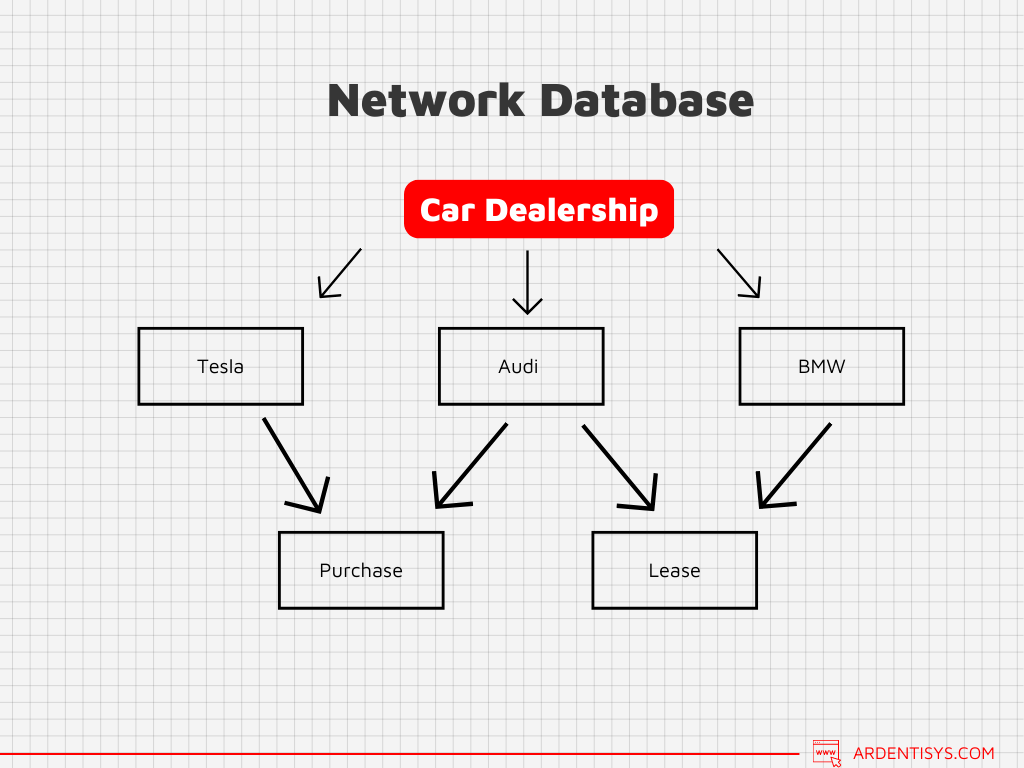
The key benefits of network database management system
- Better flexibility – there is better flexibility for the data compared to hierarchical
- Access – Easier and speedier access to the data compared to the hierarchical structure
The limitations of a network database management systems
- Non-flexible – compared to other models such as an RDBMS, it still lacks flexibility
- Complex structure – compared to the hierarchical structure it is more complex with records being stored using pointers
Network database system database management system technologies
Some of the database technologies that have adopted the network database management system include are:
- Integrated Data Store (IDS)
- Integrated Database Management Systems (IDMS)
- Raima Database Manager
Ardent data engineering services
The Ardent team of highly skilled data engineers have worked on many data engineering projects whether that is building a TB data lake to collate data from multiple disparate sources or building robust, scalable data pipelines with AWS infrastructure. If you are looking to work with data engineers proficient in world-leading technologies that have a proven track record of success, we can help.
Get in touch to find out how you can unlock your data potential or explore our data engineering services.
Ardent Insights

Which Platforms Are Ahead in AI-Ready Data Pipelines?
At Ardent, we have spent years helping organisations design, modernise and operate the data foundations behind critical reporting, analytics and decision-making. That experience gives us a clear view of what now separates AI-ready businesses from those still struggling to get value from their data. It is not the amount of data they hold, or even [...]
Read More... from The four types of database management systems
Making Your Existing Data Pipelines AI-Ready
From Stable Infrastructure to Adaptive Intelligence Most organisations do not need more data. They need their existing data to work better. At Ardent, we spend a significant amount of time inside large-scale client data platforms that are already mature, operational, and delivering value. These are not greenfield environments. They are complex ecosystems built over years, [...]
Read More... from The four types of database management systems
AI-Powered ETL in Amazon Redshift
When the Warehouse Starts Doing the Work In our previous piece, we explored how ETL (Extract, Transform, and Load) is evolving into adaptive, intelligent systems. In Redshift environments, we are now seeing what that shift looks like in practice. For most of its life, Amazon Redshift has been treated as the final step in the [...]
Read More... from The four types of database management systems
Services
About
UK
US
India

