Why Data Pipelines Must Become Intelligent Systems
21 April 2026 | Jack Bailey


Most data platforms do not fail because they lack capability. They fail because they cannot adapt to the speed at which their environment changes.
At the centre of this challenge is ETL.
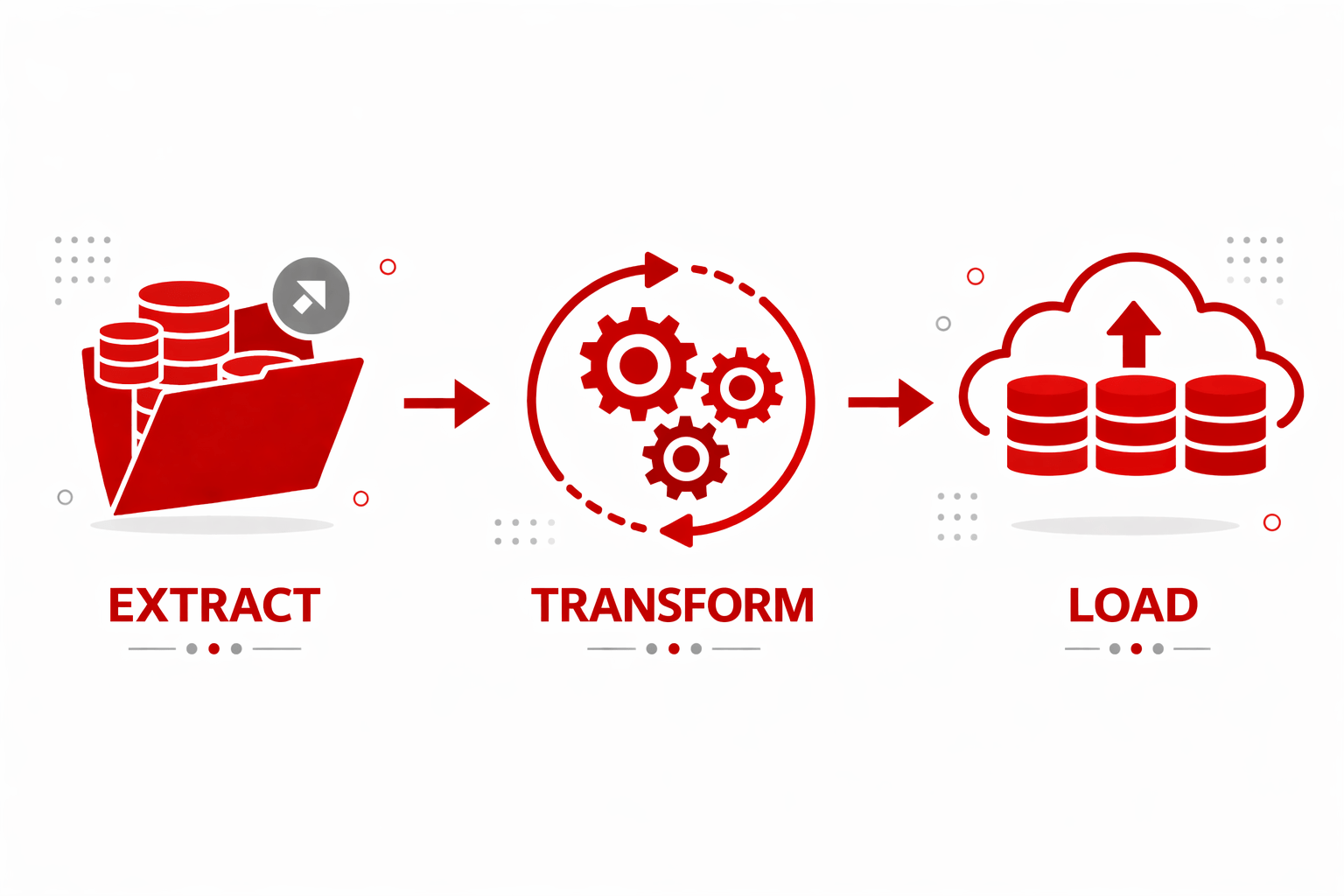
ETL (Extract, Transform, Load) is the process by which raw data is ingested, structured, and made usable for analytics, reporting, and operational decision-making. For decades, it has been the backbone of enterprise data platforms.
But it was designed for a different era, one where data structures were relatively stable, workloads were predictable, and business logic evolved gradually.
We have seen this first-hand. At Ardent we have worked with organisations managing large volumes of complex, multi-source data, where pipelines must reconcile inconsistent structures and deliver reliable outputs under increasing pressure.
In these environments, building robust, scalable pipelines has enabled teams to move from fragmented data to a unified, accessible view, improving both accuracy and the speed at which insight can be delivered.
As complexity increases, pipelines are pushed beyond their original design assumptions, turning manageable variability into continuous change that demands constant adjustment and more resilient, scalable approaches to processing data.
Today, data ecosystems are in constant motion. New sources are introduced continuously, schemas evolve without warning, and business definitions shift with changing commercial priorities.
Under these conditions, pipelines become progressively harder to maintain, not because they were poorly designed, but because they were built for a world where change was slower and more predictable.
This is the inflection point many organisations are now reaching.
ETL is no longer just a technical layer for moving data. It has become a limiting factor in how quickly a business can interpret and act on new information.
When Scale Becomes a Constraint
As organisations grow, the issue is no longer whether pipelines work, but whether they can keep up with the demands placed on them.
The symptoms are rarely immediate. Pipelines continue to run and data continues to flow, but the cost of maintaining that flow increases quietly. Small upstream changes trigger unexpected downstream effects. Delivery timelines extend, and confidence in data begins to erode.
What emerges is not a single failure, but systemic friction:
- In retail and consumer environments, we have seen how maintaining a consistent view of products, pricing, and customers becomes increasingly difficult as both data volumes and business definitions evolve, leading to delays and growing reliance on manual workarounds.
- In telecommunications, pipelines supporting organisations such as Ericsson and AT&T struggle to keep pace with the scale and velocity of telemetry data, turning performance monitoring reactive and limiting the ability to respond in real time.
- In media and measurement, our work with Ipsos has shown how fragmented audience, panel, and digital data create persistent reconciliation challenges, resulting in increasingly complex and fragile reporting processes.
- In financial services, similar pressures emerge under constant regulatory and product change, where pipelines must continuously adapt while maintaining consistency, increasing validation overhead and slowing the delivery of trusted insight.
Across industries, the pattern is the same.
Pipelines that were once enablers of scale begin to constrain it. Engineering effort shifts from building new capabilities to preserving existing ones. Data latency increases, trust decreases, and the organisation’s ability to respond to change is reduced.
At this stage, the challenge is no longer technical efficiency. It is organisational agility.
From Static Pipelines to Adaptive Systems
If the limitation of traditional ETL is its inability to keep pace with change, the next step is not simply to scale it further, but to change how it operates.
The shift toward AI-powered data systems is not about adding automation on top of existing pipelines. It is about introducing adaptability into their core.
Traditional ETL relies on predefined logic. Adaptive systems respond to change based on observed patterns in data, workloads, and usage.
In practice, this introduces new capabilities:
- Schema evolution detection: identifying structural changes upstream and adjusting transformations without full rewrites
- Dynamic workload optimisation: adapting execution based on volume, latency, and system conditions
- Early data quality detection: surfacing anomalies before they propagate downstream
- Usage-aware processing: prioritising data based on how it is consumed
The objective is not full autonomy. It is resilience.
Pipelines are no longer continuously re-engineered to handle change. They are designed to absorb it.

Performance as an Early Signal of a Deeper Shift
One of the first visible effects of this shift is improved performance.
In traditional environments, optimisation is an ongoing, manual effort. At Ardent, our engineers identify bottlenecks, refactor transformations, and continually tune execution to maintain acceptable performance.
In adaptive systems, these adjustments happen continuously at the system level. Performance is maintained through alignment with real-world conditions rather than intervention.
Across modern data platforms, this approach is delivering measurable gains, with some workloads seeing improvements of up to 40%, not through isolated tuning, but through continuous, system-level optimisation. (Databricks)
But performance is only the most immediate outcome.
What it reflects is a deeper change: optimisation is no longer an activity. It becomes an inherent property of the system.
This changes how data platforms operate:
- Data is processed according to current conditions, not fixed assumptions
- Engineering effort shifts from maintaining stability to enabling new capabilities
- Systems scale without introducing the same degree of fragility
The result is sustained performance under changing conditions. Platforms no longer just support the business; they keep pace with it.
The New Risk: Adaptability Without Trust
As pipelines become more adaptive, a new constraint emerges, trust.
Traditional pipelines are predictable by design. Their behaviour is defined by fixed rules, making outputs relatively straightforward to trace and validate.
Adaptive systems change that dynamic.
As transformation logic becomes more responsive, it also becomes less visible unless transparency is intentionally built in. Without it, the system’s ability to adapt can outpace the organisation’s ability to understand it.
This introduces new questions:
- How are decisions validated when logic is no longer entirely static?
- How is consistency maintained as systems continuously adjust?
- How do business users trust outputs they cannot easily trace?
We find our clients at Ardent are already encountering this challenge. Adaptive, AI-driven pipelines can be technically successful but fail to achieve adoption because confidence is missing.
The limiting factor shifts again.
It is no longer the ability to process or adapt. It is the ability to make that adaptation transparent, governed, and aligned with the business.
Adaptability, on its own, is not sufficient. It must be paired with trust.
In practice, this requires:
- Clear lineage and traceability
- Explainable transformations
- Consistent governance frameworks
- Alignment with business definitions
Without these, adaptability introduces uncertainty. With them, it becomes a foundation for confident, real-time decision-making.
What This Looks Like in Practice
From our work at Ardent across enterprise environments, the impact of adaptive ETL is most visible where operational complexity and constant change begin to expose the limits of traditional pipelines. When adaptability is introduced at the right points, friction is reduced and systems respond more effectively to changing conditions.
In retail, pipelines adjust to evolving product catalogues and pricing structures, improving demand signal processing and reducing delays in inventory and sales reporting.
In telecommunications, adaptive approaches enable pipelines to manage high-volume telemetry with changing schemas, while identifying performance issues earlier and reducing the overhead of maintaining complex systems.
In media and streaming, adaptive pipelines manage evolving content metadata, ad delivery signals, and cross-platform audience metrics. This improves the consistency of viewership reporting and enables faster responses to audience trends.
In financial services, where regulatory and product change is constant, adaptive pipelines help maintain consistency in reporting, reduce validation overhead, and improve confidence in outputs.
Across large-scale platforms, the outcomes are consistent:
- Reduced need for continuous performance tuning
- Earlier detection of data quality issues
- Improved resilience to upstream changes
What is notable is not any single improvement, but the consistency of the outcome.
The Ardent Approach to Intelligent Data Systems
At Ardent, we do not treat ETL as a collection of pipelines. We treat it as a system-level capability that underpins how an organisation uses data.
Our experience delivering data platforms for organisations such as, Ericsson, Ipsos and AT&T has shown that the core challenge is not building pipelines that function under ideal conditions. It is designing systems that continue to function as those conditions evolve.
This perspective shapes how we approach every engagement:
- Adaptability is designed from the outset: Change is assumed to be constant, not exceptional
- AI is applied where it delivers measurable impact: The focus is on reducing operational friction, not introducing unnecessary complexity
- Governance and transparency are embedded: Adaptability is balanced with trust and control
- Data platforms are aligned with real-world operations: Systems reflect how the business actually functions, not just how data is structured
By integrating these principles, organisations move beyond maintaining pipelines toward operating intelligent data systems that scale with the business.
What Organisations Should Do Next
For organisations looking to evolve their data platforms, the transition to adaptive ETL should be approached as a progression rather than a wholesale replacement.
The most effective starting point is to reassess how ETL is positioned within the architecture.
From there:
- Strengthen the foundation: Ensure data models, governance, and quality processes can support intelligent optimisation
- Identify high-friction pipelines: Focus on areas where fragility or complexity expose the limitations of traditional ETL
- Introduce AI incrementally: Target specific use cases, such as schema adaptation or performance optimisation, to build confidence
- Maintain transparency and control: Ensure adaptive systems remain explainable and aligned with business logic
What This Means Now
The shift from static pipelines to intelligent data systems is not a future state, it is already underway. As data environments continue to accelerate in complexity and change, the organisations that succeed will be those that design for adaptability from the outset, without compromising trust, transparency, or control.
At Ardent, our focus is on helping enterprise organisations move beyond maintaining pipelines and head towards building systems that evolve over time and seamlessly adapt to new technology paradigms.
Ardent Insights

Which Platforms Are Ahead in AI-Ready Data Pipelines?
At Ardent, we have spent years helping organisations design, modernise and operate the data foundations behind critical reporting, analytics and decision-making. That experience gives us a clear view of what now separates AI-ready businesses from those still struggling to get value from their data. It is not the amount of data they hold, or even [...]
Read More... from Why Data Pipelines Must Become Intelligent Systems
Making Your Existing Data Pipelines AI-Ready
From Stable Infrastructure to Adaptive Intelligence Most organisations do not need more data. They need their existing data to work better. At Ardent, we spend a significant amount of time inside large-scale client data platforms that are already mature, operational, and delivering value. These are not greenfield environments. They are complex ecosystems built over years, [...]
Read More... from Why Data Pipelines Must Become Intelligent Systems
AI-Powered ETL in Amazon Redshift
When the Warehouse Starts Doing the Work In our previous piece, we explored how ETL (Extract, Transform, and Load) is evolving into adaptive, intelligent systems. In Redshift environments, we are now seeing what that shift looks like in practice. For most of its life, Amazon Redshift has been treated as the final step in the [...]
Read More... from Why Data Pipelines Must Become Intelligent Systems
Services
About
UK
US
India

