Databricks Vs Amazon Redshift – Data warehousing solutions
13 March 2023 | Noor Khan


Data warehousing services are a form of data management, which is designed to enable and support Business Intelligence (BI) activities such as data engineering, analytics, and being a central repository for information to be analysed and actioned.
There are a number of services available, ranging from simple to use formats designed for beginners, to advanced and highly technical. Two popular data warehousing solutions are Databricks and Amazon Redshift.
As of 2023, more than 11,636 companies are making use of Amazon’s Redshift platform, whilst in the Big Data Analytics category, Databricks is commanding 11.87% of the market share – making it one of the top platforms, comparable with Apache Hadoop (16.10%), Maestro (15.51%) and Azure Databricks (12%).
Why Databricks is popular
When it comes to handling data, whether it is a small amount or an increasingly large load, users want a program that is capable of managing the operation quickly, efficiently, and in a way that can scale up and down as required.
Databricks is a popular solution for data analytics and data engineering as it makes the process easy, with processes that are relatively easy to learn and apply. This is also backed by:
- A significant knowledge base
- Guides
- Tutorials
- Documentation
The platform can be integrated with other leading data engineering tools, and distributed on a cloud computing environment, with flexibility in processing or using Spark’s native R, an SQL interface, Python, or Scala.
Databricks key benefits
There are a number of benefits to using Databricks for handling data coding, analytics, and other data science tasks, such as:
Notebook format keeps the data organised – By working on pieces in the Spark Notebook format, data is kept organised, accessible, and editable, with clusters being able to be adjusted, deleted, or moved through the intuitive dashboard.
Spark allows for aggregating large datasets in the cloud – Because Databricks allows for different formats of data, users have the ability to drop visuals in-line into notebooks, and allow for in-line graphs and visualisations.
Different cells can be set in different coding languages – The ability to operate a notebook with more than one coding language allows for innovate functionality, and to generate solutions to challenging run processes without having to move between formats or programs.
Why Amazon Redshift is popular
Offering efficient storage, high-performance query processing, scalable data warehousing and functionality, and the resources to run at high speeds even when handling petabytes, Amazon Redshift has proven to be a popular data solution for thousands of users.
Supported by:
- Extensive knowledge base
- External cloud hosting
- A range of complementary services and functions
Redshift is used by small and large operations, and although it is sometimes considered to be more technical, there are a number of learning options and scalable features that integrate to make the platform suitable for most.
Redshift key benefits
When using the Redshift platform, some of the most commonly referenced benefits include:
High-performance query processing – The resources available to the platform and users, allow for datasets to be handled with efficient storage and fast querying.
Setup is relatively easy – There is a significant amount of automation and integration in the platform, which allows setup, deployment, and management of tasks to be handled with automated provisioning – making it easier to use than some other platforms.
Payment is on a pay-as-you-go basis – There are a number of different payment options for the service, and with no up-front costs, users are only being charged for what they are using.
Data can be structured and centralised for time-efficient data queries – By utilising the AWS platform and the variety of tools available, data can be structured and organised to provide better insights and more effective use of time and resources.
Limitations and challenges of Databricks and Redshift
As with any technology, there are limitations and challenges to both Databricks and Redshift, depending on what the service is needed for, and how the user intends to utilise the functions.
Cons of Databricks
- Users need a certain level of data-analytic knowledge to use
- Databricks analytical tools are not as comprehensive on the dashboard as some others
- The data backup feature is not consistently reliable
- CPU optimisation may not perform as well as other competitors
Cons of Redshift
- The service is not completely managed
- Choices can significantly impact the price of the service
- The platform is not a multi-cloud solution
- The platform is not a serverless architecture
Alternative technologies to Databricks and Redshift
There are other technology partners that provide similar services to Databricks and Redshift, which may be more appropriate for different tasks, or as a complement to the existing service.
Some of the most popular options include:
Google BigQuery – Part of the Google Cloud suite of services, the technology allows for the handling of large volumes of data, and processing for business analytics, as well as having machine learning capabilities. The platform has been used by world-renowned brands, including – Renault, Macy’s and TUI Travel.
Snowflake – Although the Snowflake platform was not created to serve the same functions as Databricks, over time, there has been significant development in the service and areas of overlap which make Snowflake a popular choice when handling data needs.
Vertica – The Massive Parallel Processing (MPP) data warehouse platform has been designed to work with big data and is a popular choice for clients who are looking for options involving increasingly large data sets.
Many of the existing platforms and programs are capable of integrating with one another, but it is important that when determining what platform you chose that you look at what your team are working with, and whether they are capable of changing to a different format (should the software require it), and that the needs of the platform are scalable and cost-effective for both current and future needs of your business.
Explore data warehousing technologies, making the right choice
Ardent data warehousing service
Ardent have leveraged both Databricks and Amazon Redshift for multiple client projects with the technology chosen based on its fitting to client requirements. If you are dealing with large volumes of complex data and want to store it in an organised and accessible, we can help. Our data warehousing solution ensures your data is secure, scalable and accessible. Explore the stories of our clients succeeding with Ardent data engineering services:
- Improving data turnaround by 80% with Databricks for a Fortune 500 company
- Ensuring timely data availability for real-time, mission-critical data
- Robust, scalable data pipelines with AWS infrastructure driving insights for global brands
Get in touch to find out more or to get started on unlocking the potential of your data.
Ardent Insights

Which Platforms Are Ahead in AI-Ready Data Pipelines?
At Ardent, we have spent years helping organisations design, modernise and operate the data foundations behind critical reporting, analytics and decision-making. That experience gives us a clear view of what now separates AI-ready businesses from those still struggling to get value from their data. It is not the amount of data they hold, or even [...]
Read More... from Databricks Vs Amazon Redshift – Data warehousing solutions

Making Your Existing Data Pipelines AI-Ready
From Stable Infrastructure to Adaptive Intelligence Most organisations do not need more data. They need their existing data to work better. At Ardent, we spend a significant amount of time inside large-scale client data platforms that are already mature, operational, and delivering value. These are not greenfield environments. They are complex ecosystems built over years, [...]
Read More... from Databricks Vs Amazon Redshift – Data warehousing solutions
AI-Powered ETL in Amazon Redshift
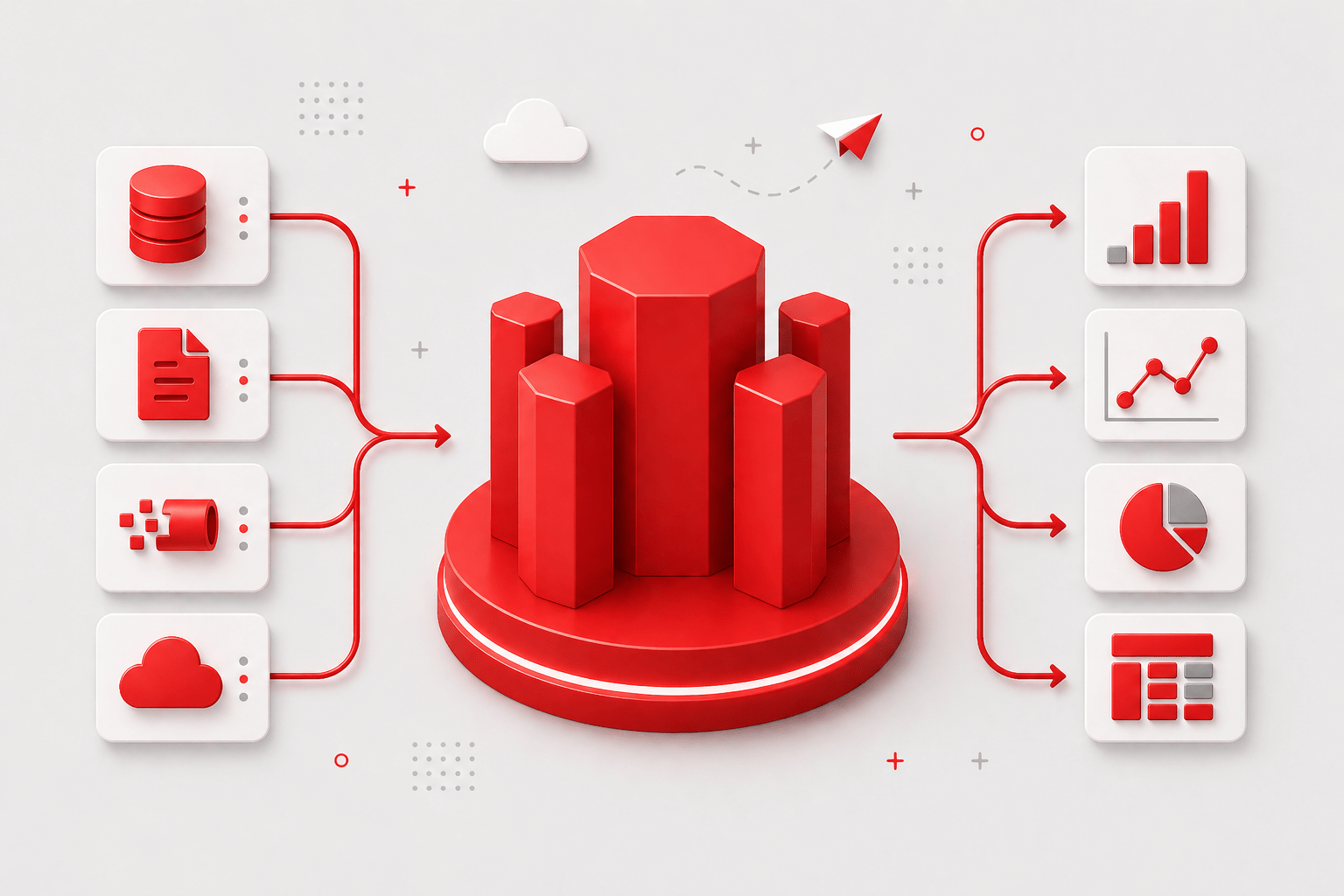
When the Warehouse Starts Doing the Work In our previous piece, we explored how ETL (Extract, Transform, and Load) is evolving into adaptive, intelligent systems. In Redshift environments, we are now seeing what that shift looks like in practice. For most of its life, Amazon Redshift has been treated as the final step in the [...]
Read More... from Databricks Vs Amazon Redshift – Data warehousing solutions
Services
About
UK
US
India

