The four types of application integration and how they compare
18 November 2022 | Noor Khan


Application integration is the connection between two or more apps. As businesses grow and evolve, they adopt multiple software and apps to increase efficiency across their organisation, this can range from CRMs, supply chain management software, accounting software and more. These software alone can provide invaluable benefits to organisations, however, connected they can provide one source of truth with powerful insights to drive growth and inform business strategy.
In this article, we will look at the four types of application integration which will help you decide what is right for you.
Presentation level integration
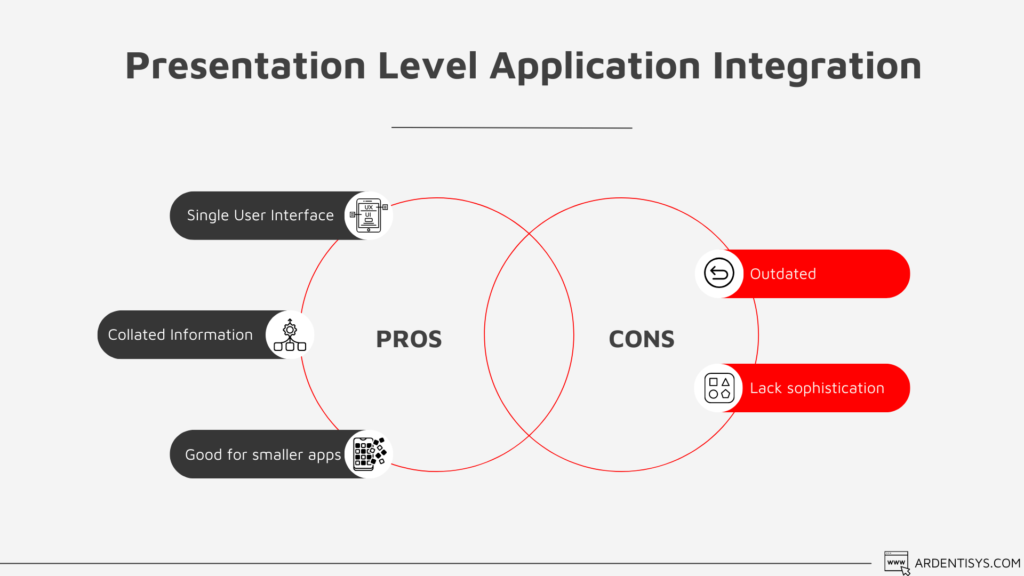
Presentation level is one of the mature forms of app integration which collates two or more apps into one by creating a common User Interface (UI). The information is collated with middleware technology and presented on the UI. This form of app integration is considered outdated and although it is still used it's not considered as sophisticated as other forms of integration.
Key benefits of presentation-level integration
- One User Interface
- Collated information
- Good for smaller apps
Limitations and challenges of presentation-level integration
- Considered an outdated method of integration
- Is less sophisticated compared to others
Business process integration
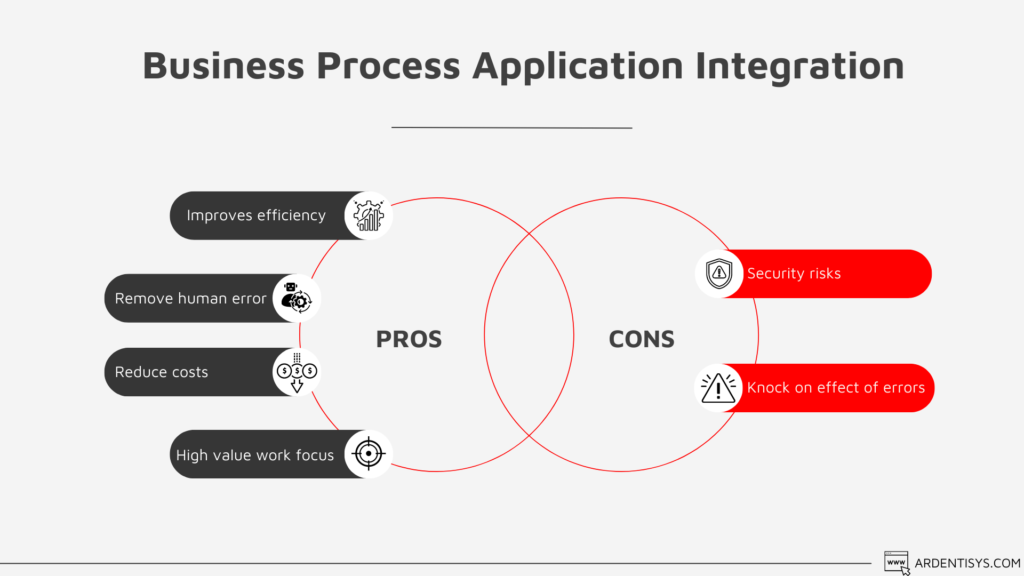
The main aim of business process integration is to improve efficiency in an organisation with the adoption of business automation and AI. Business process integration connects two or more apps to improve workflows and ensure they are as efficient as possible. With teams utilising multiple applications and software for day-to-day activity, which are disparate in nature, it can reduce productivity and provide room for error. An example of business process integration is the connection between your CRM and accounting software, once an order is generated in your CRM, an invoice is automatically created in your accounting software.
Key benefits of business process integration
- Improve workflows and efficiency
- Mitigate room for human error
- Enable teams to focus on high-value work
- Reduce operational costs
Limitations and challenges of business process integration
- Increase security exposure with integrated systems
- Issues, errors or breakdowns may impact the entire system rather than just one application.
Data integration
The data integration of two or more apps enables the data systems to communicate and exchange data with one another. As organisations and their data grow in volume, source, type and format, without integration, businesses can become less efficient without enriched and collated information. The most common format of app integration level is using an intermediate data format, which can be understood by both applications. Alternatively, developers can write code which can then enable the two applications to communicate. However, the first method offer scalability and efficiency whereas the second method may require constant updating of the code.
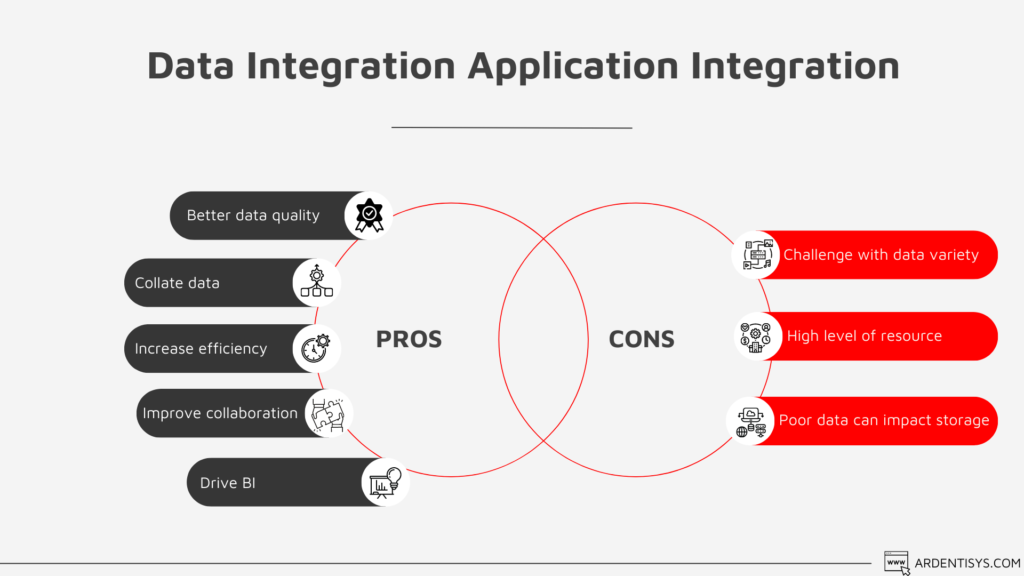
Here are some key benefits of data integration and some challenges you face.
Key benefits of data integration
- Improved data quality
- Collated data for one source of truth
- Improve collaboration
- Drive Business Intelligence
- Increase in efficiency
Limitations and challenges of data integration
- The more variety in data (format, source, type) the more challenging it can be to collate it
- Growing volumes of data can require a high level of resources (e.g. storage)
- Poor quality or outdated data can pose a challenge with speed and storage
Communication level integration
Communication level integration is the method used in both business process integration and data level integration. Essentially, it looks at how apps communicate with each other in these types of integrations. For communication-level integrations APIs (Application Programming Interfaces) are created to be the communicator between the apps. API is a middleware technology which can employ multiple methods to facilitate communication which includes the following:
- P2P (Point-to-Point)
- Hub-and-Spoke
- ESB (Enterprise Service Bus)
Read the full article on the different approaches to application integration and hose to choose the right one for you.
Types of application integration for you - choosing the right one
Choosing the right type of application integration will largely depend on your challenges and your business goals and objectives. If you are looking to improve productivity and streamline your organisation's operations, then business process integration may be the ideal option for you. On the other hand, if you are looking to better understand your business activity and data to drive BI, then consider data-level integration. If you are still unsure about which is the right method for you, then reach out to an expert that can help you navigate your application integration.
Ardent app integration services
If you are employing multiple disparate applications and are trying to better understand your business the ardent app integration service is for you. The Ardent experienced and highly skilled software engineers can come on board to help understand your challenges to deliver any type of application integration which is fit for you, your business and your requirements to:
- Effectively manage your data
- Automate workflows
- Increase sales
- Provide a seamless experience
- Improve efficiencies
..or achieve whatever organisational goal you have with Ardent app integration. Get in touch to find out more or set up a discovery call so we can help find the right solution to meet your unique needs.
Ardent Insights
Which Platforms Are Ahead in AI-Ready Data Pipelines?
At Ardent, we have spent years helping organisations design, modernise and operate the data foundations behind critical reporting, analytics and decision-making. That experience gives us a clear view of what now separates AI-ready businesses from those still struggling to get value from their data. It is not the amount of data they hold, or even [...]
Read More... from The four types of application integration and how they compare
Making Your Existing Data Pipelines AI-Ready
From Stable Infrastructure to Adaptive Intelligence Most organisations do not need more data. They need their existing data to work better. At Ardent, we spend a significant amount of time inside large-scale client data platforms that are already mature, operational, and delivering value. These are not greenfield environments. They are complex ecosystems built over years, [...]
Read More... from The four types of application integration and how they compare
AI-Powered ETL in Amazon Redshift
When the Warehouse Starts Doing the Work In our previous piece, we explored how ETL (Extract, Transform, and Load) is evolving into adaptive, intelligent systems. In Redshift environments, we are now seeing what that shift looks like in practice. For most of its life, Amazon Redshift has been treated as the final step in the [...]
Read More... from The four types of application integration and how they compare
Services
About
UK
US
India

