Why you need a data warehouse for your data
17 October 2022 | Noor Khan



Modern businesses create and process a lot of information from a lot of different sources. It can be difficult to make the best use of this data when you have to track down all the relevant channels, have multiple systems and servers to search, and need different skill sets to operate each platform.
In order to streamline your time and use the information you have gathered to its fullest potential, having a central hub and reliable access to metrics and other measuring tools can make all the difference. This is where data warehousing services come in.
What is a Data Warehouse?
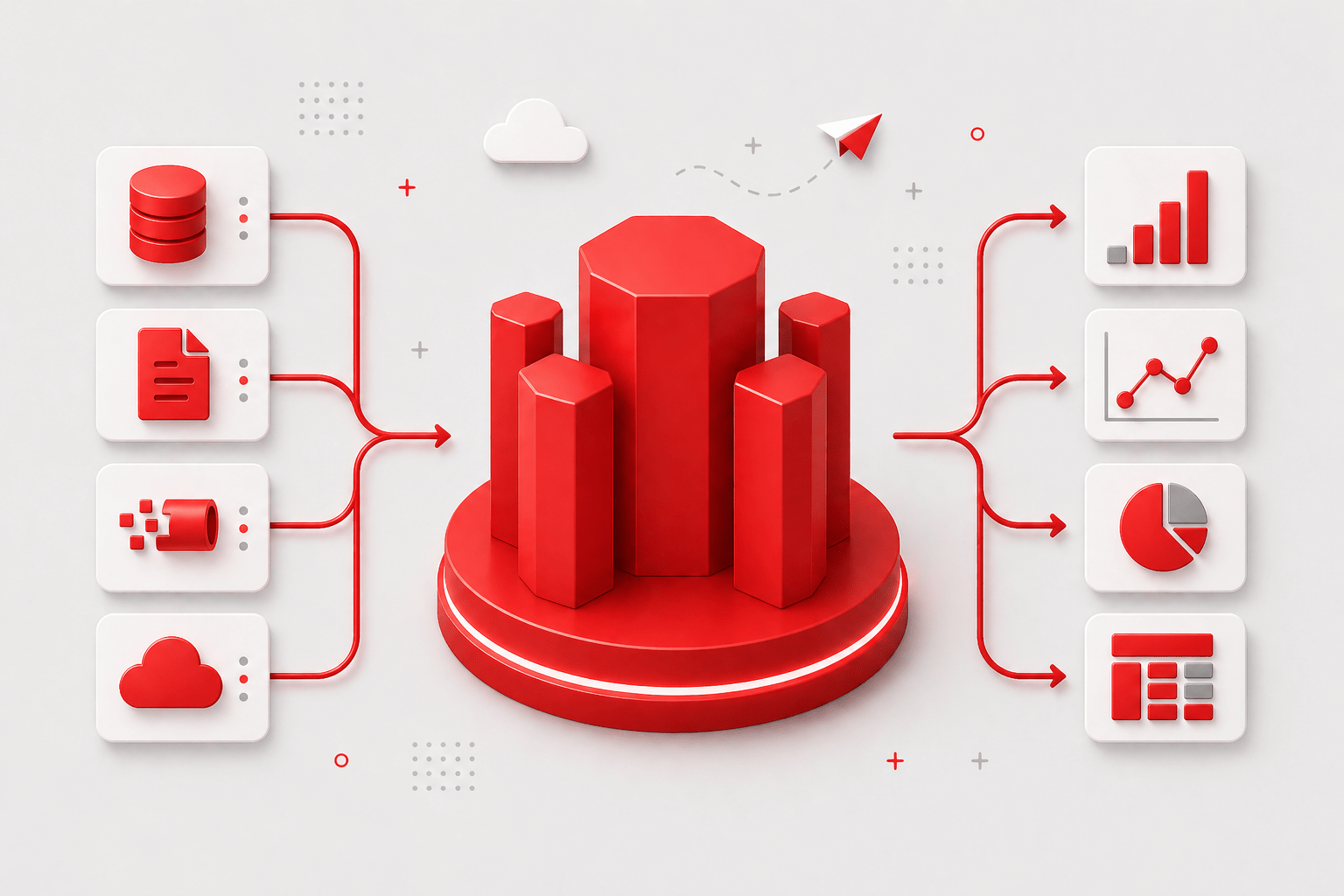
As the name suggests, a data warehouse is, at its core, a central location which houses all of a company’s data. This data is drawn in from multiple locations (as many as the company sets up the service to handle), and makes this data accessible, searchable, organised, and available for more complex tasks – such as generating reports, forecasting trends, training machine learning models, and feeding data to Business Intelligence (BI) tools.
Read more about the data warehousing architecture.
What are the key benefits of using a Data Warehouse?
There are multiple benefits to utilising a data warehouse, especially as there are a range of different platforms available – allowing data engineering teams to choose the technology that meets their specific needs, functions with compatibility to their existing data, and can be operated with their personal level of experience. Some other key benefits include:
Efficiency
The first key benefit that comes from data warehousing is efficiency – a company can centralise their data collection, ensure that it’s compatible with their needs, and search through the content without having to analyse multiple sources. This also has the benefit of saving time, and budget, as less time will be required to identify critical data.
In-depth analysis
The second key benefit comes from being able to perform high-level analysis and comparative research into the content. Decision makers can use the data to conduct SWOT (Strength, Weakness, Opportunity, and Threat) analysis for their business, or to derive insights from data trends.
Business Intelligence
Thirdly, the data warehouse can act as a support for operational processes, such as being able to consolidate research, financial data, or sales results. This can provide fast, accurate insights into a company’s core processes, and identify areas of cost-saving, development, or restructuring within the business.
What are the main Data Warehouse technologies to utilise?
Depending on the size of the organisation, and the skill level of the technician operating the data warehouse, there are multiple options – and the best fit for a company will depend on their specific needs.
Some of the most popular data warehouse solutions include:
Amazon Redshift
A scalable service which is suitable for small businesses as well as larger companies.
Find out more about our Amazon Partnership.
Google Big Query
A serverless multi-cloud data warehouse which is suitable for medium and large businesses.
Microsoft Azure SQL
A cloud-based relational database, supported by over 100 different services and tools. Suitable for small businesses and scaling upward.
Find out about our Microsoft Partnership.
Choosing the right technologies
The technology you choose should be suitable for your immediate business needs, but also capable of scaling upwards as your business grows. By carefully identifying what you want to achieve, and working with experts who know the technology intimately, you can improve your business and drive your data to better use.
Ardent data warehouse service
Our engineers have worked with a wide variety of clients to architect high-performing, secure and scalable data warehouses to meet business goals and requirements. With data engineers proficient in world-leading technologies including Microsoft and AWS, we can help you uncover powerful insights and unlock the potential of your data with our data warehouse service. Get in touch to find out more or to get started.
Explore our data engineering services.
Ardent Insights

Which Platforms Are Ahead in AI-Ready Data Pipelines?
At Ardent, we have spent years helping organisations design, modernise and operate the data foundations behind critical reporting, analytics and decision-making. That experience gives us a clear view of what now separates AI-ready businesses from those still struggling to get value from their data. It is not the amount of data they hold, or even [...]
Read More... from Why you need a data warehouse for your data

Making Your Existing Data Pipelines AI-Ready
From Stable Infrastructure to Adaptive Intelligence Most organisations do not need more data. They need their existing data to work better. At Ardent, we spend a significant amount of time inside large-scale client data platforms that are already mature, operational, and delivering value. These are not greenfield environments. They are complex ecosystems built over years, [...]
Read More... from Why you need a data warehouse for your data
AI-Powered ETL in Amazon Redshift
When the Warehouse Starts Doing the Work In our previous piece, we explored how ETL (Extract, Transform, and Load) is evolving into adaptive, intelligent systems. In Redshift environments, we are now seeing what that shift looks like in practice. For most of its life, Amazon Redshift has been treated as the final step in the [...]
Read More... from Why you need a data warehouse for your data

Services
About
UK
US
India

